


 Erdinç Kaddoura
Updated Date:
The Domain Was the Easy Part: Building a Towing Brand While Your Ad Budget Is Under Attack
The details are drawn from the pattern that repeats across towing, recovery and roadside accounts in Australia — and, with the nouns swapped, across every category where a generic domain and a high-intent keyword point at the same thing. If parts of it describe your own account, that is why it was written.
There is a particular kind of small business owner who does everything in the right order and still ends up losing money on Google Ads. He is worth writing about, because the usual advice — your website is bad, your keywords are wrong, your agency is lazy — does not apply to him, and he knows it. He did all of that properly. That is exactly why his situation is so confusing to him.
He spent fourteen years driving tilt trays for other operators around Western Sydney before buying his own truck. When he decided to go out on his own, he did not start with the truck. He started with the name.
What a Generic Domain Actually Buys You

He bought a two-word .com.au that says precisely what he does and where he does it. No invented brand name, no misspelling, no hyphen. The kind of domain a person can hear once on a radio ad and type correctly a week later. It cost him more than his first month of advertising, and he paid it without much hesitation, because the logic seemed obvious: this is the phrase people are already typing.
He was not wrong about the logic. He was wrong about the timing.
A generic domain in a high-intent category is a compounding asset. Its value is not in what it does on day one — it is in what it accumulates. Every time someone sees it at the top of a search result, every time it is on the side of a truck at a set of lights, every time a panel beater passes it along, a small deposit is made into recognition. Five years of that and you stop having to buy every customer, because a share of them arrive typing your name directly.
That is the whole thesis behind paying a premium for a name like that. And it is entirely sound. But it rests on an assumption almost nobody states out loud:
The assumption: that the people seeing your name are people.
Hold onto that sentence. Everything that goes wrong for him follows from it.
He did the rest properly too. The website loads in under two seconds. The phone number is a tappable link, above the fold, not an image. There are separate pages for the corridors he covers. The homepage says what he tows — cars, 4WDs, vans, motorcycles, small machinery — and what he doesn't, which quietly saves him a dozen wasted phone calls a week. If you ran it against a standard landing page checklist, it would pass. His page speed is better than most of his competitors'.
Then he turned the ads on.
Week One: The Auction Meets the Brand
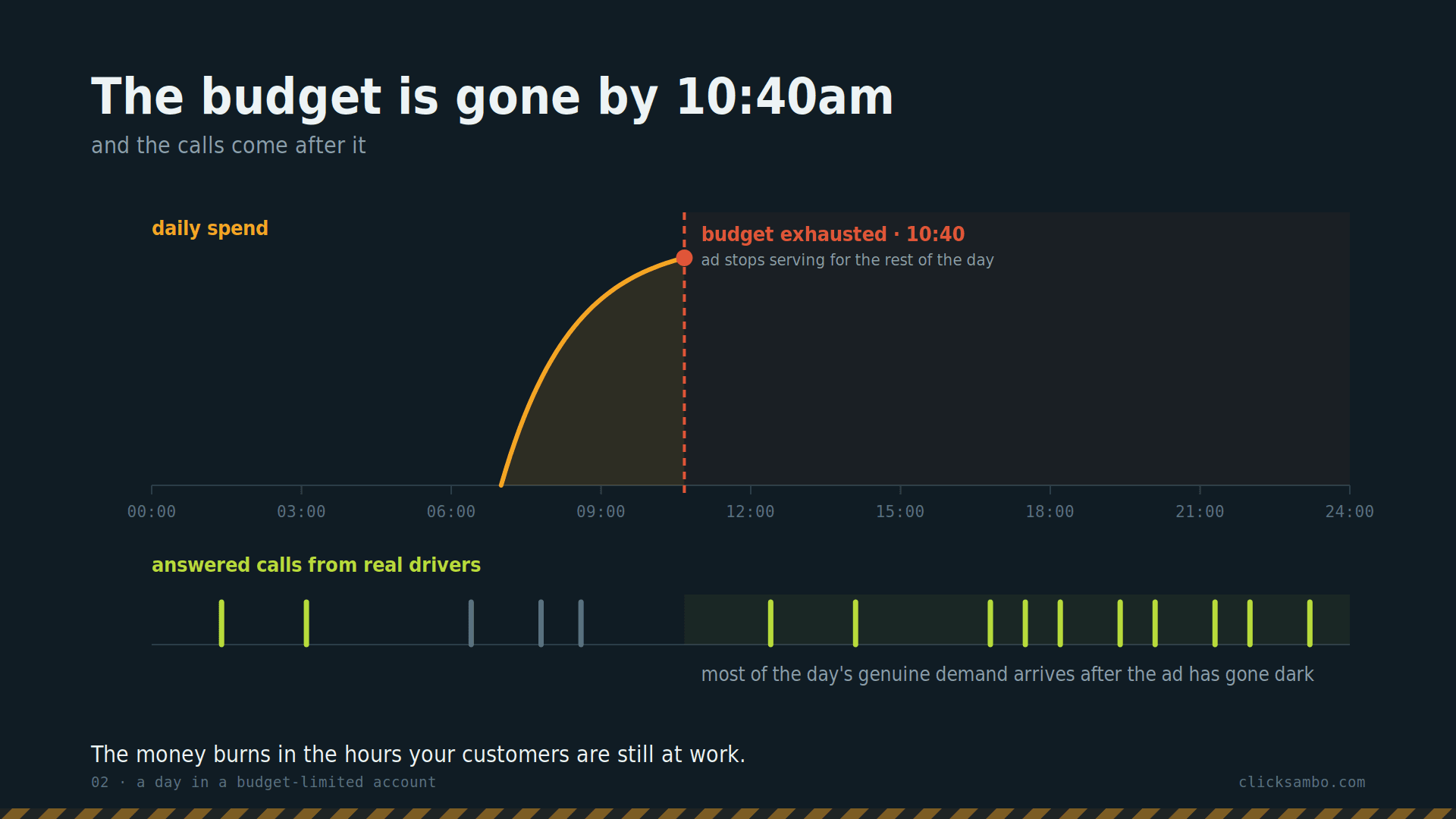
| Monday | Budget gone by 10:40am. | wo calls. One is a man asking how to get his car out of a council impound yard, which is not a service this business provides and never has been. |
| Wednesday | Budget gone before 11 | No calls at all. Forty-one clicks. |
| Thursday. | Watches it happen in real time on his phone between jobs | Spend climbing steadily from 7am. The graph looks like a business with demand. His phone does not ring once before two in the afternoon. |
| Friday | The whole budget again, | one job booked — a six-kilometre tow that barely covers the fuel and the clicks it took to win it. |
At the end of the month, the jobs that came from the panel beater down the road outnumber the jobs that came from the ads by a wide margin. He arrives at the conclusion nearly everyone in his position arrives at, and it is the wrong one: advertising doesn't work for a business like mine.
The reason it is wrong is that he is not looking at a demand problem or a website problem. He is looking at a visibility problem — the specific kind that comes from being easy to find.
The Part Nobody Told Him: The Best Work in This Trade Is Never in the Auction

Before going anywhere near the click data, there is a structural fact about Australian towing that reframes everything else, and that almost no marketing advice written for this trade mentions — because almost all of it is written for the American market.
Accident towing is allocated, not won. In Victoria, accident tow trucks are licensed under the Accident Towing Services Act 2007, licences are issued to the vehicle rather than the driver, and in the Melbourne controlled area including the Mornington Peninsula, jobs are handed out on a roster basis through an allocation centre. Trade towing — breakdown recovery, private property, machinery — was deregulated. The distinction is set out plainly in Transport Victoria's guidance for the towing industry. NSW runs a comparable structure under the Tow Truck Industry Act 1998, with operator licences through NSW Fair Trading, TT plates, and a job allocation scheme governing attendance at accident scenes.
No amount of ad spend puts you at an allocated accident scene. That work is simply not for sale on Google.
And much of what remains is spoken for before the driver opens a browser. Most Australians who break down ring the auto club they already pay a membership to. Insurer assist lines take another slice. Dealer, fleet and panel shop contracts take another.
So here is the honest shape of the market he bought a premium domain to compete in: he is not bidding for towing work. He is bidding for what is left over after the allocation schemes, the auto clubs, the insurers and the contracts have taken theirs. And so is every other independent operator in his corridor, all of whom were pushed into the same narrow channel for the same reason.
This is why the auction feels so much tighter than the size of the industry suggests. And it is why the next section matters more here than it would in a category with room to breathe. When the addressable slice is thin, every wasted click is a much larger proportion of what was winnable in the first place. Losing 10% of your traffic to something that was never going to call is an annoyance in a broad market. In this one it is the difference between a truck that moves and a truck that doesn't.
The Attack Does Not Look Like an Attack
He eventually gets full access to his own account — which, as covered in the London repair business post, is the single change that separates advertisers who can diagnose their problem from advertisers who cannot. He spends a Sunday reading it. Four things come out.
The same handful of addresses, over and over
One address clicking nine times in a week. Working hours, never a call, never a scroll. A stranded driver clicks once and either rings or closes the tab.
The incentive behind this is worth stating plainly, because people dismiss it as paranoia until they see the arithmetic. His daily budget is fixed. The moment it empties, his ad disappears for the rest of the day — and the only name left on that keyword belongs to the operator two suburbs over. A competitor does not need to outbid him to remove him from the auction. They only need to make his budget run out before lunch. This is not a theory; it sits inside the industry definition of invalid click activity, and it is the specific problem competitor fraud protection exists to address. We have written about the mechanics separately in how competitor fraud protection reduces wasted ad spend.
And here is where the domain comes back into it. He is the easiest business in his corridor to identify. His name is the search term. Every competitor who has ever typed their own keyword to check their ad position has seen him sitting at the top of it. He did not just buy visibility to customers — he bought visibility to everyone bidding against him. The asset and the exposure are the same asset.
The two ways an ad gets attacked — and why only one of them gets refunded
This distinction explains more about an account than almost anything else, and it is rarely spelled out.
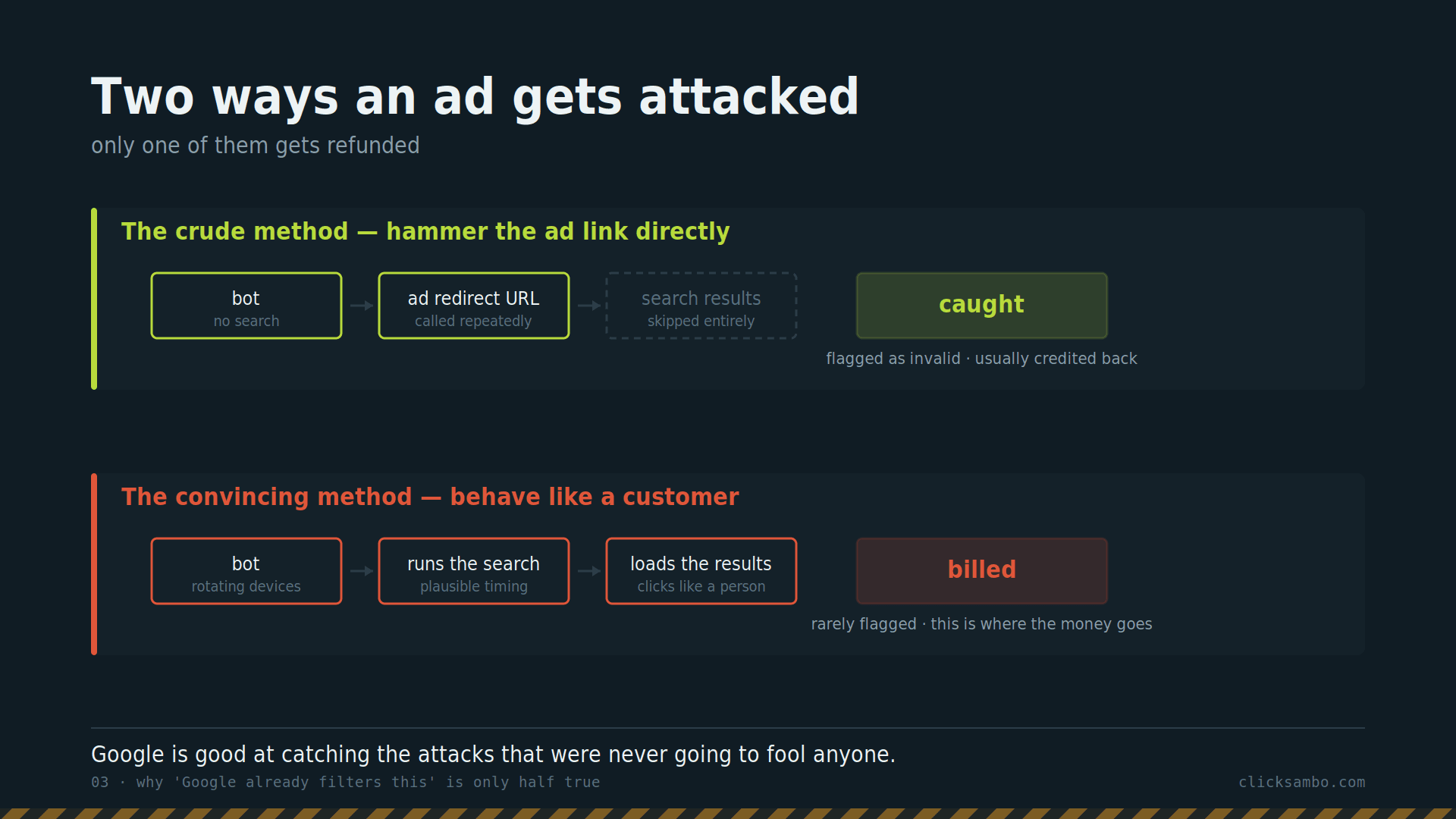
The crude method is to call the Google ad link directly, over and over, without ever performing a search. No query, no results page — just the redirect URL hammered repeatedly. It is trivial to automate, and it is also fairly easy to spot: the pattern is obviously non-human, so it tends to land in Google's own invalid click detection and get credited back. Alarming to watch, largely self-correcting on the invoice.
The convincing method is to behave like a customer. Run the search, load the results page, click the ad the way a person would. Different addresses, real devices, plausible timing. Nothing about the individual event looks wrong, so it is far less likely to be flagged, far less likely to be credited, and it is what quietly consumes a budget month after month.
Clicks that behave nothing like a stranded driver
Be careful with the standard advice here, because applied bluntly it will cost a towing operator real money. Most guides tell local businesses to treat clicks between 1am and 4am as suspicious. Towing is genuinely a 3am business. Switch those hours off and you have handed them to whoever stayed on.
The signal to look for is behavioural, not chronological. A driver on a roadside taps the call button within roughly fifteen seconds; they do not read your About page. So what you want is clicks with no call tap, no scroll, and a two-to-four-second session, clustered in the same hours where your genuine overnight callers ring almost immediately. Same hour, opposite behaviour. That contrast is the tell, and it is the sort of thing a click-level traffic log shows and a monthly summary report never will. It is also why ad clicks and site visits are not the same number — the gap between them is often the first visible symptom.
Traffic from outside the service area
His location setting is on the default, which reaches people interested in the area rather than only people in it. In a country this size that default is expensive: he is paying Sydney metro rates for clicks from Adelaide and for people researching interstate vehicle moves he does not take. The fix is one dropdown, explained in presence versus interest targeting.
Search terms he never meant to buy
Broad match quietly buys an enormous amount of adjacent vocabulary in this trade. Pull the search terms report and it separates into four groups:
➔ Career and licensing: tow truck jobs, tow truck licence NSW, how to become a tow truck driver, tow truck driver salary.
➔ Buying trucks: tow truck for sale, tilt tray for sale, used tow trucks Australia.
➔ Impound and enforcement: car impounded NSW, council impound release, police impound fees. Real people, urgently searching, with a problem he cannot solve.
➔ Scrap and removal — the expensive one: cash for cars, free car removal, scrap car pickup, car wreckers near me. Enormous volume in Australia, vocabulary directly adjacent to his, and close to zero overlap with a paid tow — anyone searching it expects to be paid, not to pay.
If you check one thing after reading this, make it that last group. Then build the negative keyword list from what you find, and tighten match types around your core terms. If your ads are appearing for things you would never have bought deliberately, this troubleshooting guide covers the usual causes.
None of this is unusual
Independent measurement has been putting numbers on this for years. Lunio's Global Invalid Traffic Report, published in January 2026 and built on 2.7 billion paid ad clicks across six platforms, eight industries and ten countries between August 2024 and July 2025, found that 8.51% of all paid ad traffic is invalid — roughly one click in twelve — amounting to an estimated US$63 billion wasted globally over the period, as reported by MediaPost. The same body of research consistently finds lead-generation businesses carry materially higher rates than ecommerce, which is exactly the category a towing service sits in.
The sources vary in what they are counting: straightforward bot traffic, coordinated click farms, botnet-driven clicking, and the harder category of sophisticated invalid traffic that is specifically built to survive platform filtering. The exact figure moves by methodology, industry and country. The direction never does.
You Cannot Build a Brand for an Audience That Isn't There

Now back to the domain, because this is the part that makes his situation different from a generic "wasted ad spend" story — and the part that costs him the most.
He is not only trying to book jobs this month. He is trying to build a name, on the strength of an asset he paid a premium for, on the theory that visibility compounds into recognition and recognition eventually reduces what he has to pay for each customer. That theory is correct. But it depends entirely on the assumption from the top of this article: that the people seeing his name are people.
Three things break when they aren't.
One: the deposit never lands. Impressions served to bots build no recognition. A click farm does not remember your brand. Money he believes he is spending on becoming known in Western Sydney is, in part, being spent on being seen by machines that will never call anyone.
Two: the algorithm learns the wrong lesson. This is the more damaging half, and it is invisible on any dashboard. Smart Bidding optimises toward whatever resembles engagement. Feed it fake engagement and it will confidently spend more of his money in exactly the wrong place — bidding harder on the placements and audiences that generate the most invalid traffic, because to the system those look like the best-performing ones. As automated bidding takes over more of the account, covered in our guide to the 2026 Google Ads AI updates, the cost of feeding it corrupted data rises rather than falls. Clean input has stopped being a nice-to-have.
Three: he draws the wrong strategic conclusion. This is the one that actually ends businesses. Having seen four months of spend produce almost nothing, he concludes that digital advertising does not work for towing, and he stops. The premium domain sits there doing nothing but hosting a website nobody is sent to. He goes back to relying on the panel beater and word of mouth — which is to say, back to a ceiling he bought the domain specifically to escape.
The failure was never the strategy. It was that the strategy was executed against a traffic mix he could not see and had no way to measure.
Every Way Out, Ranked by What It Actually Costs You

He has more options than the internet usually admits. Here they are honestly, worst to best, including the ones that do not involve buying anything.
Option 1 — Raise the budget
The instinct, and the most expensive mistake available. If a proportion of traffic is invalid, increasing spend increases the absolute amount lost while leaving the proportion untouched. You are buying more of the same mix. If your budget is capping out early, understand why before you raise it — "limited by budget" and "drained by invalid traffic" look identical on the surface and require opposite responses.
Option 2 — Change agency
Sometimes justified. Usually not the actual fix. Most agencies were working with what they had: no exclusion lists, no clean conversion data, and a brief measured in impressions. A new agency inheriting the same corrupted signal reaches the same place in three months. Change the brief before changing the supplier — access to the account, a search terms report monthly, and reporting built on jobs dispatched. If you use an agency, onboarding them into your protection layer is straightforward and generally makes the relationship better, not worse, because it gives them a fairer measure of their own work.
Option 3 — Claim invalid click refunds from Google
Worth doing, and genuinely worth understanding: the platform does filter a meaningful volume of invalid traffic and does issue credits for what it detects. The refund request process is open to anyone, and we have a full walkthrough in the guide to Google Ads refunds for invalid clicks.
Its limits are structural rather than a criticism. It is retrospective — you are asking for money back, not preventing the spend. It operates on the platform's detection, timeline and terms. And a claim supported by your own timestamped click log, with geography and behaviour attached, is treated very differently from a claim that is simply asserted. Which means this option gets substantially stronger once you have the data from a later option on this list.
Option 4 — Block IP addresses manually
Start here, because it is free and it teaches you what your traffic looks like. You can see and manage blocked IPs and IP ranges directly in Google Ads, and knowing what an IP range actually is makes the exercise far less mysterious.
Then it hits four hard walls. Google Ads caps how many exclusions a campaign can hold. Exclusions apply going forward and refund nothing already spent. Anyone on a mobile connection, a proxy, VPN or Tor has a new address within minutes — which, in a trade where nearly every real customer is on a mobile network, is not an edge case.
And the fourth is the one almost nobody realises. An IP exclusion stops your ad being shown to that address; it does not stop that address calling your ad link. The exclusion works on the serving side — when a device at that IP searches on Google, your ad is withheld. It puts nothing in front of the redirect URL itself, which can still be requested directly, repeatedly, by something that never went near a search box. So "block this IP completely" is not technically available to you, on any campaign type. It is a narrower instrument than the name suggests.
Manual blocking handles yesterday's attacker, not today's. If you have already tried it and the budget still drains, that specific experience has its own post.
Option 5 — Give up on paid search and go elsewhere
The one people actually choose, usually without saying so. Move the money to SEO, to social, to vehicle signage, to the panel beater relationship.
Some of that is genuinely good business. But as a response to this problem it is a retreat, not a solution — and it is a peculiar one for someone who bought a premium exact-match domain, because organic and paid feed the same asset. The recognition compounds across both. Abandoning the channel where your name appears at the moment of highest intent, in order to avoid a traffic-quality problem that is measurable and fixable, throws away the reason the domain was worth buying.
Option 6 — Filter the traffic before it costs you
This is the option that changes the shape of the problem rather than its size, and the honest case for it is narrower than most vendors make it: it does not create demand, it does not lower the auction price directly, and it does not win you an accident allocation or an auto club contract. What it changes is response time. Instead of finding a bad pattern three weeks later on a Sunday night, the pattern is detected on the click and excluded before it repeats.
In practice that means per-IP threshold rules that block an address on its second or third click inside a defined window, device fingerprinting that survives IP rotation — which is what actually handles mobile-network traffic — bot scoring at the click level, and a click log detailed enough to make Option 3 above worth attempting. Our PPC fraud protection and customisable bot detection rules pages set out how that works in practice, and how ClickSambo works covers the setup end.
If You Go That Route, Here Is What to Actually Compare
There is a real market of tools in this category and you should look at more than one. The comparison that matters is not the feature grid — nearly everyone lists the same features. It is these five questions:
➔ What does it do about IP rotation? Blocking IPs alone is Option 4 with a subscription attached. Ask specifically what identifies a returning visitor after the address changes.
➔ Is the blocking rule yours or theirs? A fixed threshold that suits an ecommerce store will be wrong for a business where a genuine customer might legitimately click twice in five minutes from a roadside. You want thresholds you can set yourself, and sensible starting points by industry.
➔ Can you see the raw click log, or only a summary? A dashboard reporting "we blocked 412 fraudulent clicks" is unverifiable. A log with timestamp, IP, ASN, device, geography and on-page behaviour is evidence — and it is what turns a refund claim into a documented one.
➔ What happens to your existing tracking? Most of these tools install through a tracking template. If you already run one, or your agency does, find out how the two coexist before you sign anything — this is the single most common setup problem in the category.
➔ How do you verify it is working? Ask for the specific indicators to check rather than accepting a headline number. And if you are already running another analytics or attribution tool, check whether it runs alongside or replaces it.
Whatever you choose — including a competitor's product — measure it against those five. The category improves when buyers ask harder questions of everyone in it, including us.
Call-Only Is Ending — And That Is Good News For Your Budget
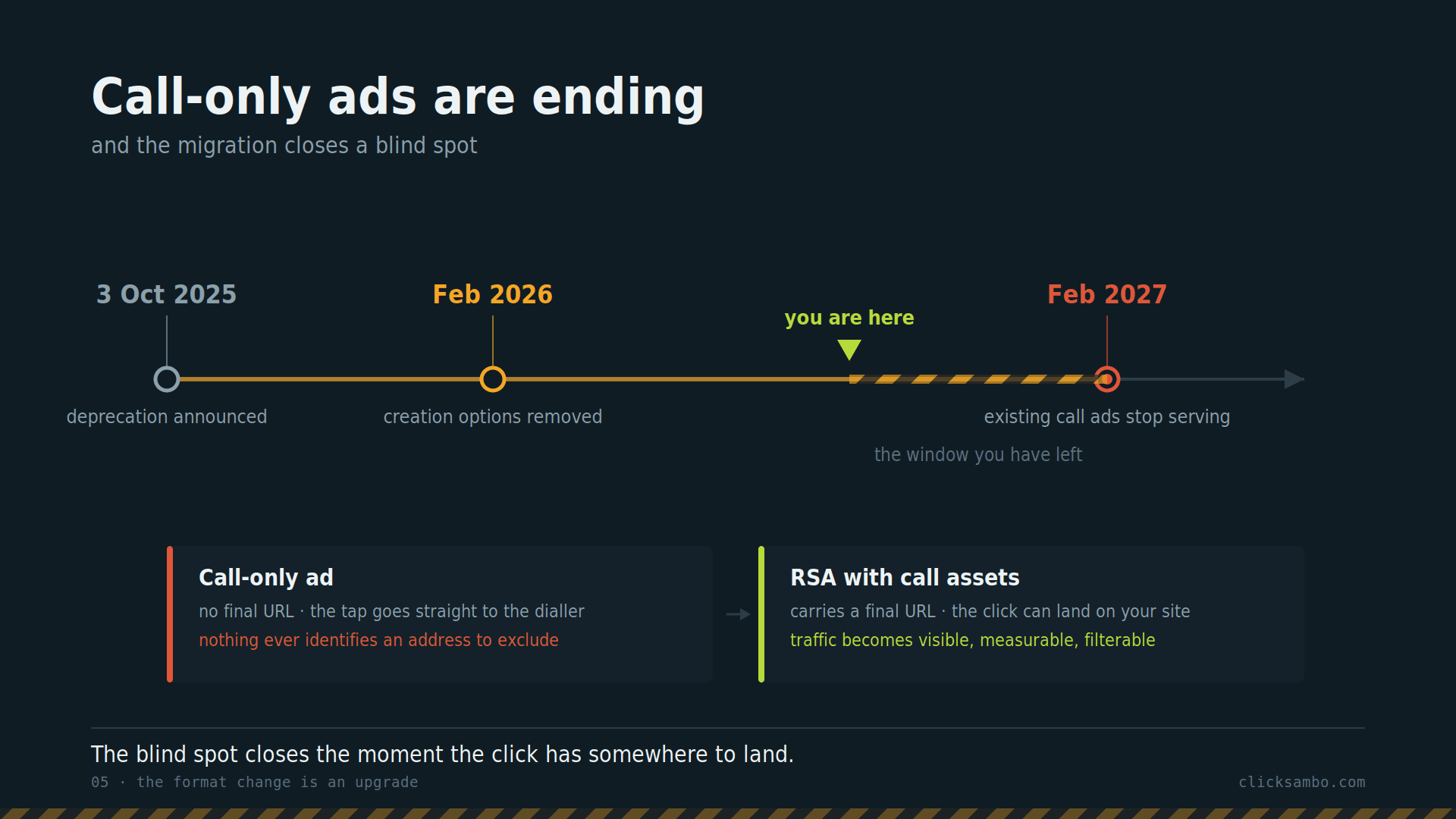
If you are in towing, a large share of your budget has probably lived in call-only ads for years, and it should have — the format matched the trade. A driver on a hard shoulder does not want to read a website.
That format is being retired. Google announced the deprecation on 3 October 2025: from February 2026 the options to create new call ads were removed, and in February 2027 existing call ads stop serving altogether. The migration path is responsive search ads with call assets, where your number appears as a tappable element alongside the rest of the ad. If you have not started that migration, it is now the most time-sensitive item in your account — ahead of everything else in this article.
Notably, part of Google's stated reasoning was fraud-adjacent: call-only ads required no URL and no landing page, which meant there was nothing to verify a business against, and operators who were not what they claimed could present themselves as legitimate.
That detail matters to you for a reason that is easy to miss.
Why the blind spot existed, precisely
Click protection identifies a visitor by what happens after the click — a tracking code on the page observes the device, the session, the behaviour. A call-only tap produces no page view. It goes straight to the dialler.
So the limitation was never that exclusion was forbidden. Google does support IP exclusions on search-network campaigns, and account-level exclusions apply across your whole account. The problem was upstream of that: with no site visit, nothing ever identified which address to exclude. You cannot exclude a visitor you never saw. That is a detection gap, not a permissions gap, and it is worth being precise about the difference — plenty of write-ups get this wrong in both directions.
What the migration changes
An RSA with call assets carries a final URL. Traffic that clicks through lands on your site, where it becomes visible, measurable and filterable in exactly the way your keyword search traffic already is.
In other words, the format change closes the blind spot. The part of your spend that has been the hardest to account for becomes the part you can audit. If you have been unable to explain where a chunk of your call budget went for the last few years, the migration is the moment that becomes answerable.
Taps that go straight to the dialler via the call asset still produce no site visit, so that slice stays outside click-level detection. But it is a slice now, rather than the whole campaign.
What covers the gap in the meantime
For the taps that never reach a page — during migration, and for call-asset taps afterwards — detection runs through conversion tracking, and the response is negative signalling: the sources identified as worthless are fed back to Google so its own optimisation steers away from those profiles when deciding who to show the ad to.
The distinction is worth setting expectations around:
➔ Exclusion is a gate on who gets shown the ad. A listed address stops being served your ad when it searches. Deterministic, and available on your search campaigns — though note it is a gate rather than a seal: it withholds the ad, it does not stop your ad link being requested directly by something that skipped the search entirely.
➔ Negative signalling is a correction to the map. No individual tap is guaranteed to be stopped. What moves is the population the platform chooses to serve the ad to, away from profiles that have been producing taps that go nowhere. It works probabilistically and over weeks rather than instantly.
And this is precisely the inverse of the problem described earlier. Invalid traffic teaches your bidding algorithm the wrong lesson about who your customer is, then sends it looking for more of the same. Negative signalling teaches it the right one. Where you cannot close a gate, you correct the map instead.
Our support note on call-only ads and call assets covers what is and is not supported through the transition.
Leave the budget split alone
If keyword search and call-focused campaigns are running at roughly equal weight, that split is not the fault, and nothing here asks you to change it. Most towing and roadside accounts land there for good reasons.
What is usually missing is that the search half — the half where clicks land on your site and hard exclusion is available — is running unfiltered. That is the half already sitting on a surface you can verify, and in an account that is essentially two lines, cleaning it improves the model that both lines draw on.
If you do run display, it is the line to question rather than your call campaigns: lowest intent, highest invalid traffic rate, least defensible in a trade where the customer is stranded and dialling. Most towing accounts keep it small or skip it, and that instinct is correct.
Track calls properly — and use the gap between surfaces as a diagnostic
Set call conversion tracking with a sensible minimum duration. A genuine tow enquiry is not a nine-second call; without a threshold you are telling the system every tap is a success, wrong numbers included. That is the same signal corruption problem in a different costume.
Duration is the first quality signal but it should not be the only one. Be deliberate about which call events you count as conversions, and make sure the ones you count are the ones that turn into jobs — a caller who rings for ninety seconds and books a tow and a caller who rings for ninety seconds to ask whether you buy scrap cars are not the same outcome. If both are counted, the model learns to find you more of the second.
Then compare the two surfaces directly, which a two-line account makes unusually easy. If your filtered search line produces a booked job at a materially better cost than your call campaigns produce an answered call, that gap is the closest measurement available of what is happening where you cannot yet see. It will not tell you which taps were bad. It will tell you roughly how much is going missing.
The short version
Call-only ads stop serving in February 2027 and can no longer be created. Migrate to RSAs with call assets now, not in December.
Until you do, and for call-asset taps afterwards, there is no way to catch an address and shut it out on the spot — not because Google forbids IP exclusion on search campaigns, but because a tap that never reaches your site never identifies an address to exclude in the first place.
That does not leave the campaign undefended. Feed the bidding system the negative signals drawn from the surface you can verify, along with call quality signals that have a real duration threshold behind them, and the platform's own optimisation begins steering toward the people who actually ring and away from the profiles that never do.
Expect that as a falling cost per answered call over a period of weeks — not as fake calls disappearing overnight. If someone promises you the second thing, they are describing a product the ad format does not allow to exist.
Two honest caveats. First, negative signalling is not exclusion. It shifts who the platform decides to serve your ad to; it does not guarantee any particular bad tap is stopped. Expect a trend, not a switch. Second, how quickly that correction takes hold, and how much of it carries across campaign types, is not something Google publishes a figure for. Treat the direction as sound and the magnitude as something to measure in your own account. Compare cost per answered call before and after, not cost per tap.
The First Fortnight: A Sequence, Not a Rebuild
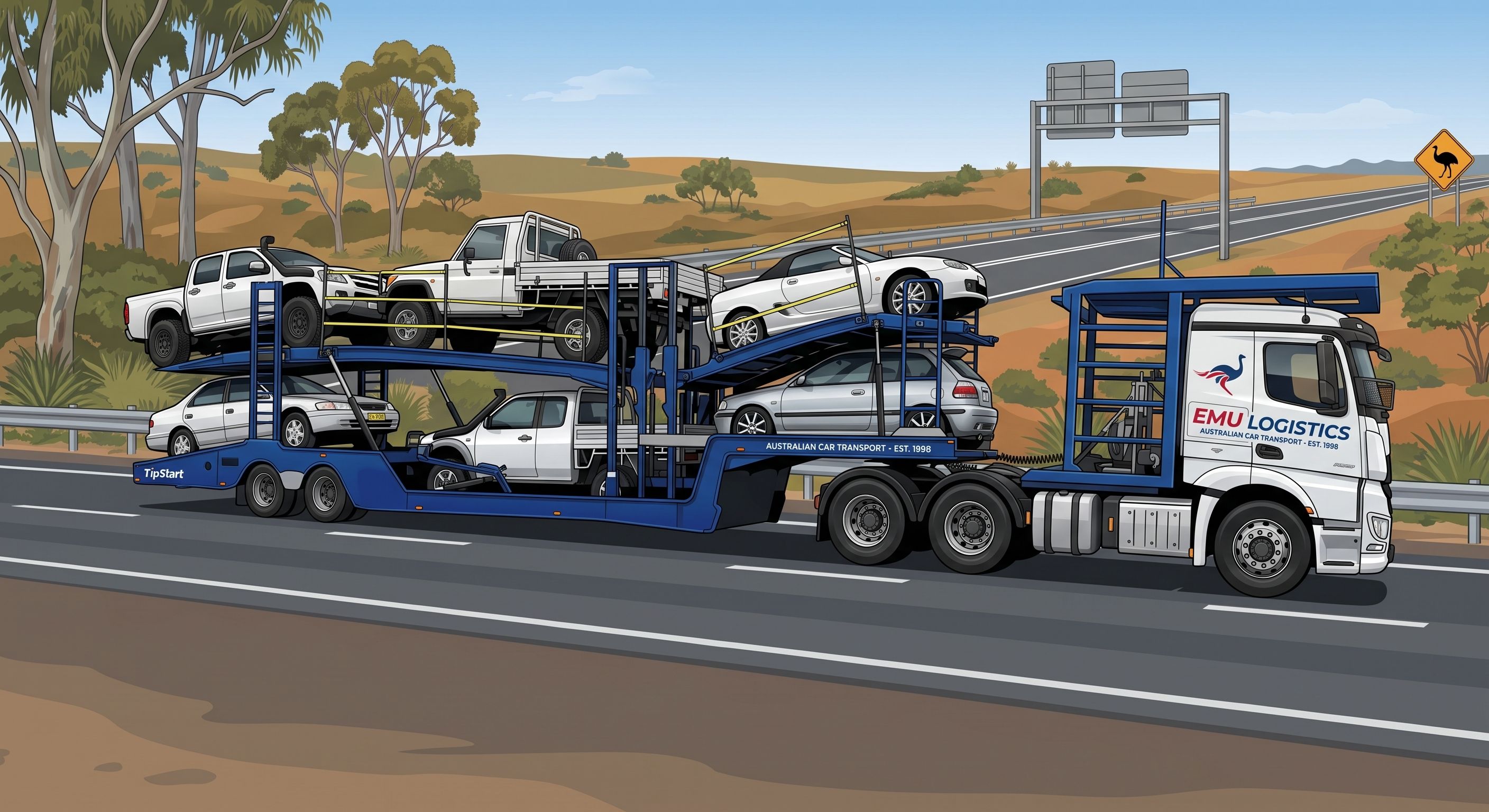
Do not do all of this at once. Cheapest-first is both lower risk and the only way to know which change did what.
Days 1–2. Get full account access in your own name. Switch location targeting to presence. Pull thirty days of search terms and build the negative list from the four groups above.
Days 3–5. Tighten match types on core keywords. Check your call ad migration status first — if you still have live call-only ads, adding a final URL and moving to RSAs with call assets outranks everything else on this list, because it both beats the February 2027 deadline and makes that traffic filterable. Leave the budget split alone otherwise; no money needs to move. Make sure the keyword search side is actually being filtered, and set a minimum call duration on your call conversions. Then break performance down by network and, if you run display at all, scale it back gradually rather than switching it off — usually Display and Search Partners in this trade. Give them a small allowance and watch how they behave once traffic is being filtered. A channel that earns its way back up is more durable than one you killed in frustration. If you are unsure which campaign types you should be running at all, start here.
Days 6–9. Turn on call tracking. Then look at answered calls by hour across the following weeks. Restrict or bid down only the hours you can demonstrate produce clicks and no answered calls — and be honest about whether the problem is the hour or the fact that nobody picked up at 2am. Do not solve a dispatch problem by switching off demand. General guidance on scheduling for peak hours applies, with that caveat.
Days 10–14. Add filtering and let it collect a baseline before you judge anything. Check your ad copy and landing page still match, since cleaner traffic will lift Quality Score and that is where an indirect CPC improvement comes from. If you want an estimate of what the current mix is costing before you commit to anything, the ad spend loss calculator will give you a figure from your own account.
What the Domain Is Worth Once the Traffic Is Real

Nothing above makes tow truck near me cheaper. It is expensive because the open market is crowded, and it will stay that way. Nothing above wins an accident allocation, an auto club contract or a place on an insurer's panel — those are won on licensing, relationships and service record.
What changes is narrower, and worth more than it sounds. The budget stops emptying at 10:40am, so the ad is live in the evening and overnight, which in this trade is where a substantial share of the work actually is. Forty clicks means forty people with a vehicle that will not move, rather than five apprentices, ten people chasing a scrap payout and fifteen bots. The bidding algorithm starts learning from real behaviour. And the recognition the domain was bought to accumulate begins accumulating in the only place it was ever going to matter — among people who can pick up a phone.
That is the whole argument. The domain was never the hard part. Making sure the right audience sees it is.
You can see the same pattern resolve in other high-intent local categories — a local taxi service that grew leads 700% and an operator who went from one call a month to 140 leads — both dispatch businesses with the same economics as towing.
A 10-Minute Self-Check

| Location setting | presence, or presence-and-interest? If you cannot answer, it is the latter |
| Search terms, last 30 days | how many are career, impound or scrap-removal searches? |
| Click behaviour by hour | what share of overnight clicks produced a call tap, compared to daytime? Do not assume overnight is bad — measure it. |
| Repeat clicks | does any single source appear more often than a stranded driver plausibly could? |
| Call ads | do you still have live call-only ads with no final URL? They stop serving in February 2027 and cannot be recreated. |
| Call conversions | is there a minimum duration set, and does what you count as a conversion actually correspond to a booked job? |
| Clicks versus sessions | does the number in Google Ads match the number arriving on your site? |
| Display and Search Partners: | do you know what each costs and returns, separately from Search? |
| Reporting | does your monthly report contain jobs dispatched, or only impressions and CTR? |
Four or more uncomfortable answers means the problem is not that advertising doesn't work for towing. It means you are paying full metro rates, in an already narrow market, for traffic you cannot see.
Get the real bot and competitor click rate in your own account within 24 hours. Free for 7 days.
 Pricing
Frequently asked questions
More visible, which in a small competitive trade amounts to something similar. Every competitor checking their own ad position sees you at the top of the keyword, and the cheapest way to remove a budget-limited rival from an auction is not to outbid them but to empty their budget early. The domain is still the right asset. It just means the traffic-quality question arrives sooner for you than for a business nobody can find.
For the segment those channels do not cover — non-member breakdowns, private property tows, second tows, machinery moves, long-distance jobs — yes, and that segment is real. What changes is the standard you hold it to. A narrower addressable market means every wasted click is a bigger share of what was winnable, which is precisely why traffic quality matters more here than in a category with unlimited demand.
Yes, and the answer is about to get better. First the deadline: call-only ads can no longer be created and stop serving in February 2027, so migration to responsive search ads with call assets is now urgent regardless of anything else. That migration also closes the gap — an RSA carries a final URL, so traffic that clicks through lands on your site where it can be verified and filtered like any other click. Until then, and for call-asset taps that go straight to the dialler afterwards, detection runs through conversion tracking and the response is negative signalling rather than exclusion: worthless sources are fed back to Google so optimisation steers away from those profiles. Worth being precise about why — Google does support IP exclusions on search campaigns; the obstacle is that a tap which never reaches your site never identifies an address to exclude. Expect a trend on that slice rather than a switch, and measure it on cost per answered call.
It does, and it issues credits for what it detects — but the shape of what it detects matters. Crude attacks that hammer your ad link directly, with no search behind them, look obviously non-human and tend to be caught and refunded. Traffic that runs the search, loads the results page and clicks like a person is far harder to flag and far less likely to be credited. So the platform is good at catching the attacks that were never going to fool anyone, and the expensive traffic is the traffic that looks like your customers. That gap is what a third-party layer covers. See our 2026 click fraud protection guide for how the two work together rather than in competition.
Do start there — it is free and instructive. But Google Ads caps exclusions per campaign, exclusions never refund what you already spent, and mobile and VPN users change address constantly. In a trade where nearly every genuine customer is on a mobile network, that limitation is central rather than marginal.
Usually not by itself. High CPC in urgent recovery categories is normal auction pricing driven by intent and competition — and if it jumped suddenly, there are ordinary explanations to rule out first. Click fraud is what makes an already expensive click worthless. Diagnose them separately: CPC is a bidding and Quality Score question, invalid traffic is a click quality question.
Setup runs through a tracking template and a site code; the practical answer is in how much work it is to set up an account, and onboarding help is available if you would rather not touch the account yourself. The more important question is the one above it: give it a couple of weeks to collect a baseline before you judge whether it earned its place.





 Other
Other