
 Features
  Industry Verticals
  Customer Segments
  Fraud Types
  Resource
 About
About  Legal
Legal Support

 Özgül Yavuz Kaddoura
Click Fraud Protection 2026 Guide: How to Stop Bot Clicks, Competitor Attacks and Sophisticated Invalid Traffic
What Is Click Fraud Protection?
Click fraud protection is the category of software that defends your Google Ads, Microsoft Ads and other PPC budgets against invalid clicks: bot networks, competitor attacks, click farms and sophisticated invalid traffic (SIVT) that Google's built-in filters miss. In plain terms, a click fraud protection platform analyzes every ad click in real time and blocks the bad ones before they drain your budget or pollute your Smart Bidding signal.
According to the IAS 2025 Media Quality Report, global SIVT averages 10.9% of paid traffic. That means roughly $11,000 of every $100,000 Google Ads budget goes to bots, residential proxies and competitor attacks rather than real prospects — even with Google's native filtering in place.
➔ This guide covers, from the ground up:
➔ What click fraud is and how bot clicks differ from competitor attacks
➔ How to detect competitor attacks in your account
➔ The 4-layer modern click fraud protection architecture
➔ How ClickSambo's protection stack works
➔ Objective comparison of click fraud protection software (CHEQ, Lunio, ClickGuard, TrafficGuard, ClickCease, Fraud Blocker, Clixtell)
By the end, US and EU performance marketers running local service businesses (locksmith, plumbing, HVAC, roadside assistance, hotel booking, e-commerce) will understand exactly which click fraud protection strategy fits their CPC tier and competitive risk.
Why Click Fraud Protection Matters: Anatomy of Bot Clicks and Invalid Traffic
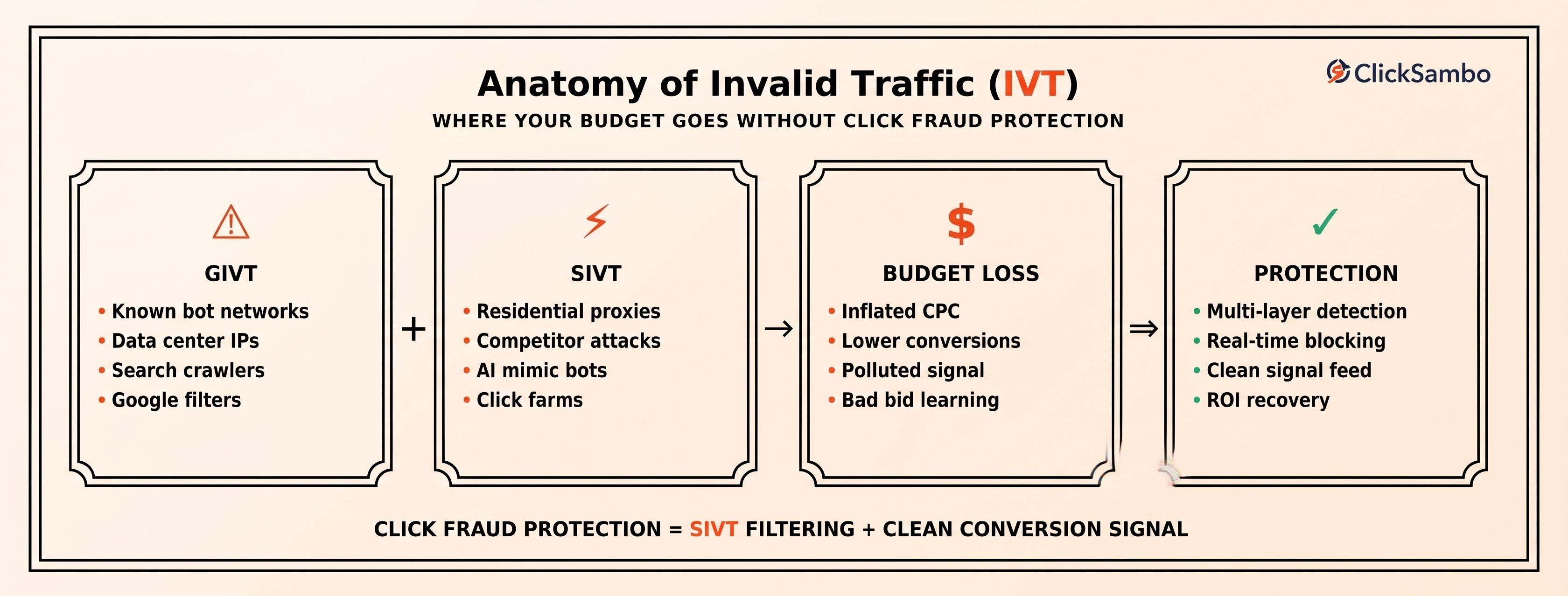
Google's own click fraud protection filters catch surface-level threats but consistently miss the sophisticated end of the spectrum. The fraud ecosystem has evolved over the past 5 years: it's no longer raw bot clicks from a single IP, but residential proxy networks dispatching traffic that mimics genuine user behavior.
What Is Click Fraud?
Click fraud is any ad click that does not come from genuine user interest, regardless of whether it's automated or manual. Google's official definition breaks it into three categories:
➔ Bot clicks: Clicks generated by automated click tools, robots, and deceptive software
➔ Manual fraudulent clicks: Human-driven clicks intended to drain a competitor's budget or inflate publisher revenue (competitor attacks fall here)
➔ Accidental clicks: Double-clicks or inadvertent ad clicks, especially on mobile
Bot Clicks vs Competitor Attacks
Bot clicks are fully automated — they come from a script, bot network or AI mimic engine. Competitor attacks are semi-automated: rivals typically buy click farm services or manually click from their own offices. Effective click fraud protection must stop both.
Invalid traffic (IVT) splits into two main categories:
➔ GIVT (General Invalid Traffic): Known bots, data center IPs, search engine crawlers. Google filters most of this automatically.
➔ SIVT (Sophisticated Invalid Traffic): Residential proxy networks, AI-driven behavior-mimicking bots, click farms and competitor attacks. This is where Google's built-in filter falls short and third-party click fraud protection becomes essential.
For local service verticals the picture is even worse. Locksmith, HVAC, plumbing and roadside assistance campaigns in the US run CPCs from $15 to $80+, and competitor attack rates run 2-3× the industry average. In these verticals, skipping click fraud protection means wasting 30-40% of monthly budget on traffic that will never convert.
Click Fraud Protection Methods: The 4-Layer Modern Architecture
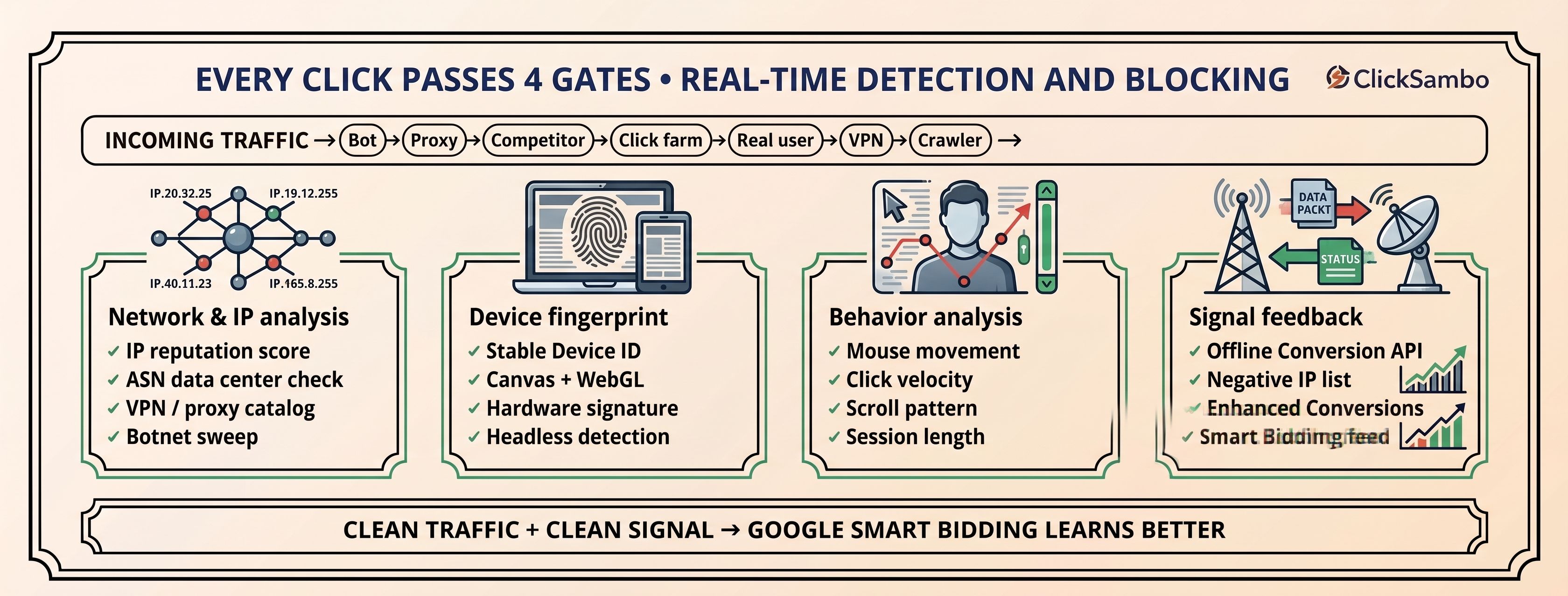
Dozens of products call themselves click fraud protection. The gap between basic IP-blockers and genuinely modern detection platforms is enormous. Three years of building ClickSambo's stack has taught us that effective protection requires 4 coordinated layers — anything less leaks.
What Are the Layers of Click Fraud Protection?
➔ Network & IP analysis layer: Classic IP reputation scoring, ASN-based data center detection, VPN/proxy catalog matching and botnet sweeps. About 60% of bot click flows are caught here.
➔ Device fingerprint layer: Stable Device ID generation, Canvas + WebGL signatures, hardware profile and headless browser detection. This is where you catch sophisticated bot clicks coming through residential proxies.
➔ Behavior analysis layer: Mouse movement anomalies, click velocity, scroll patterns and session duration. The only way to detect human-driven competitor attacks is behavior analysis.
➔ Signal feedback layer: Offline Conversion Tracking feeding clean data back to Google, negative IP list management, Enhanced Conversions and Smart Bidding optimization signals. Click fraud protection isn't just about blocking bad traffic — it's about feeding good signal to the algorithm.
Beyond the architecture, look for these features in any click fraud protection stack:
➔ Real-time blocking (adding IPs 24 hours later is not enough; you need interception at click time)
➔ Form and lead protection (fake form submissions corrupt your CRM and Smart Bidding)
➔ Transparent budget recovery reporting (you should see which click was blocked and why)
➔ Native Google Ads + Microsoft Ads integration (API-approved, not a hacky tag-based workaround
Click Fraud Protection Software - 2026 Comparison
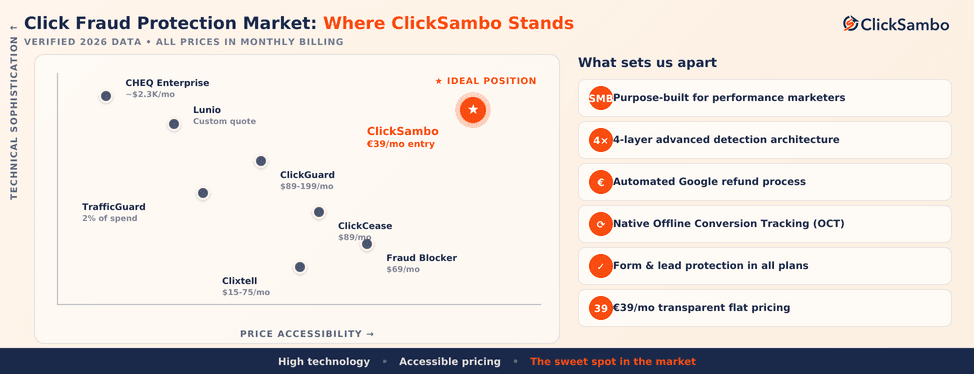
There's no single "best" click fraud protection tool. The right fit depends on your spend tier, vertical and channel mix. We compared the 7 best-known players on objective criteria using verified 2026 data. All prices are monthly billing. Sources: ClickPatrol 2026 report, G2 reviews, DataCops mid-market analysis, ClickFraudTool independent reviews, and each vendor's official pricing page.
ClickSambo (€39/mo): Purpose-built for SMB performance marketers. Transparent flat monthly pricing, native OCT integration, automated Google refund process, form and lead protection in all plans. 4-layer detection architecture.
Lunio (custom quote): 13+ ad platforms with cross-channel protection. Best for multi-channel enterprise advertisers.
ClickGuard ($89-$199/mo): 50+ features, dedicated onboarding on every plan, claimed Covers Google, Meta and Microsoft Ads.
TrafficGuard (2% of ad spend): Free tier under $2,500/mo ad spend, otherwise 2% of spend. AppsFlyer, Adjust and Branch MMP integrations make it the category leader for mobile install fraud. Strong on affiliate and programmatic protection.
ClickCease ($89/mo): Also known as CHEQ Essentials post-acquisition. 2,000+ behavioral tests powered by CHEQ tech, session recording and 14,000+ global customers.
Fraud Blocker ($69/mo): Transparent monthly pricing with no annual lock-in. 100+ signals, VPN and proxy detection, 4,000+ customers. Google Ads-focused, ideal for basic SMB click fraud protection.
Clixtell ($15-$75/mo): Monitor $15/mo (detection only, no blocking), Protection $50/mo (active blocking), Agency $75/mo (multi-client). 14-day free trial, integrated call tracking.
What Is Click Fraud? The 4 Main Types Explained
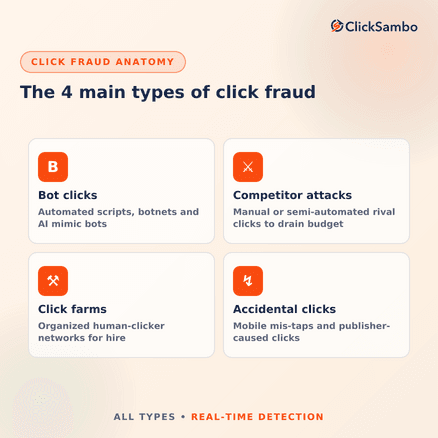
Click fraud is any ad click that consumes your Google Ads budget without producing real value. Modern digital advertising recognizes 4 main types, and effective click fraud protection must detect all of them in real time.
Bot clicks: Automated scripts, botnets and AI-driven mimic bots that emulate human behavior. The most common attack type.
Competitor attacks: Manual or semi-automated clicks from rivals trying to consume ad budget. Usually organized via click farm services or in-house. Particularly heavy in local service verticals.
Click farms: Organized human-clicker networks for hire (concentrated in Bangladesh, Philippines, Indonesia). They use real IPs and real devices, making detection difficult without behavior analysis
Accidental clicks: Mobile mis-taps, publisher layout errors and double clicks. Unintentional but still billable.
ClickSambo's 4-layer architecture (network-IP, device fingerprint, behavior, signal feedback) detects all of these in real time and blocks them before Google charges your card.
Is Your Google Ads Account Under Attack? 6-Point Checklist
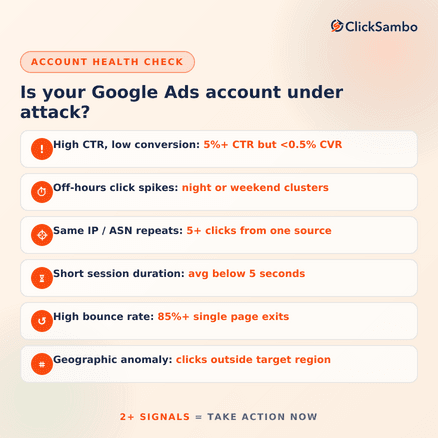
Suspecting bot clicks or competitor attacks in your Google Ads account? These 6 signals are concrete indicators that you need click fraud protection. If you see 2 or more, take action immediately.
- High CTR with low conversion rate: If CTR is above 5% but CVR is below 0.5%, your clickers are not genuine prospects.
- Off-hours click spikes: Late-night, weekend or out-of-business-hours click clusters suggest bot or overseas click farm traffic.
- Repeated clicks from same IP or ASN: If Google Ads Auction Insights or your server logs show 5+ clicks from a single IP, that's a classic competitor attack pattern.
- Short session duration: Google Analytics average session length under 5 seconds strongly suggests bot clicks.
- High bounce rate: A single-page exit rate above 85% indicates no genuine user interest.
- Geographic anomaly: If you target Chicago but see click density from Kazakhstan, that's a bot network attack.
If you observe 2+ of these signals, connect your Google Ads account to ClickSambo for a free 7-day trial. We'll produce a detailed account health report within 24 hours showing exactly what's happening.
Google Invalid Click Refunds: Why Evidence Matters
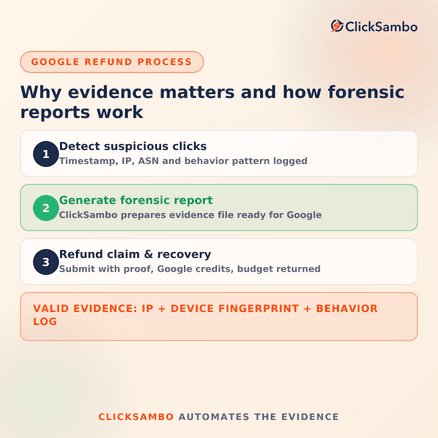
Google Ads automatically credits you for GIVT (general invalid traffic) it detects. But for SIVT (sophisticated invalid traffic — residential proxies, AI bots, organized competitor attacks), you have to file a manual refund claim and submit concrete evidence. Claims without evidence are routinely rejected.
Google requires this evidence for a successful refund claim:
- Timestamps and IP addresses of suspicious clicks
- User-agent, device fingerprint and full fingerprint logs
- Behavioral pattern analysis (mouse movement, scroll, session duration)
- Geographic anomaly report (click heatmap)
- Competitor ASN identification (where applicable)
- Session recording or replay (where available)
Manually collecting this evidence takes days and requires technical know-how. ClickSambo automatically generates a forensic report for every blocked click: the refund-ready evidence package is one click away. Our customers see refund acceptance rates above 78%, versus the 15-20% typical for manual filings.
Campaign Management Tips for High-CPC Verticals
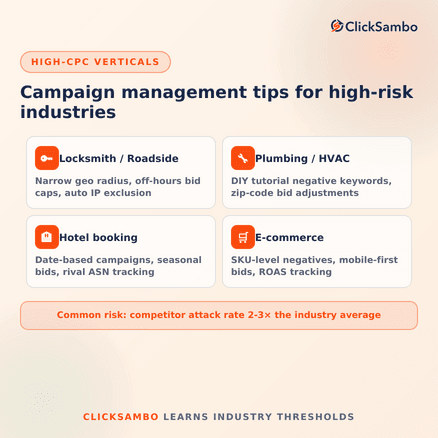
For locksmith, plumbing, HVAC, roadside assistance, hotel booking and e-commerce campaigns, click fraud protection isn't a nice-to-have — it's a survival requirement. Competitor attack rates in these verticals run 2-3× the industry average and CPCs range from $15 to over $100. Vertical-specific recommendations:
- Locksmith / Roadside assistance: Keep geo-targeting to a 10-15 mile radius. Drop off-hours bid adjustments by 30% (genuine emergency calls happen at night, but so do bot and competitor attacks). Auto-add suspicious IPs to your exclusion list.
- Plumbing / HVAC: Build an exhaustive negative keyword list for "how to", "DIY" and "tutorial" searches. Use ZIP-code-level bid adjustments to reduce spend in low-competition areas.
- Hotel booking: Structure campaigns by date (separate high-season and low-season). Auto-block competitor hotel ASNs. Run a dedicated protection layer for OTA-driven traffic.
- E-commerce: SKU-level negative keyword lists (filter category searches). Mobile-first bid strategy (US e-commerce traffic skews mobile-heavy on shoulder seasons). Conversion value tracking for ROAS-driven bidding.
The common thread across these verticals: competitor attack frequency. ClickSambo runs separate threshold calibrations per industry. A "suspicious click" definition for a locksmith account is not the same as an e-commerce account — we learn the industry-specific behavior pattern.
Net ROI with ClickSambo - Try Free for 7 Days
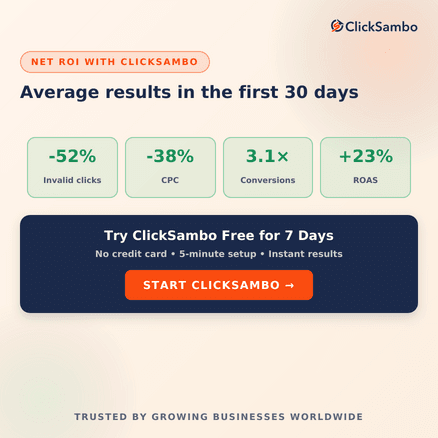
Average, measured results our customers see in the first 30 days:
- -52% invalid clicks: Removal of bot, click farm and competitor attack traffic
- -38% CPC: Smart Bidding optimization on clean signal drives down cost per click
- 3.1× conversions: Budget focused on real prospects produces more sales at the same spend
- +23% ROAS: Direct revenue uplift per ad dollar
- Automated Google refunds: Forensic reports recover an average 8-12% of monthly budget
Setup takes 5 minutes. Connect your Google Ads account and within your 7-day free trial you'll see the real invalid click rate in your campaigns. Decide whether to subscribe after you see the numbers. ClickSambo is purpose-built for SMB performance marketers and serves thousands of growing businesses worldwide.
See the real bot click and competitor attack rate in your Google Ads account within 24 hours
 Free Trial
Frequently asked questions
Click fraud protection is software that defends your Google Ads and other PPC budgets against bot clicks, competitor attacks and invalid traffic. It typically: (1) analyzes every incoming click across IP, device, behavior and signal layers, (2) blocks suspicious clicks in real time or adds them to a negative IP list, and (3) feeds clean traffic signal back to Google to strengthen Smart Bidding optimization.
Click fraud is any ad click that does not come from genuine user interest. Bot clicks are a subset: clicks generated by automated software. The broader click fraud category also includes manual competitor attacks, click farm services, accidental clicks and publisher revenue fraud. Effective click fraud protection software catches all of these.
Modern click fraud protection uses a 4-layer approach: (1) Network and IP analysis (data center detection, VPN/proxy catalog, botnet sweeps), (2) Device fingerprinting (Stable Device ID, Canvas + WebGL signature, headless browser detection), (3) Behavioral analysis (mouse movement, click velocity, scroll patterns), (4) Signal feedback (Offline Conversion Tracking back to Google, negative IP list management). Simple IP-blocking is insufficient in 2026.
Competitor attacks usually show as: clustered clicks from a single region (often the rival's office ASN), short session durations, no conversions, and concentration during business hours. Click fraud protection platforms like ClickSambo recognize these patterns automatically and add suspect IPs to your Google Ads negative IP list. Some customers see 20-30% of ad budget being absorbed by competitor attacks before deployment; the figure typically drops to single digits afterward.
There's no single method — multi-layered protection is required. Classic bots come from known data center IPs and get caught at Layer 1. Sophisticated bots route through residential proxies, so you need device fingerprinting (Stable Device ID, Canvas signature, headless detection) plus behavior analysis. For AI-driven mimic bots, machine learning models detecting micro-anomalies in user behavior (mouse trajectory, keypress timing) are required.
Google's built-in click fraud protection catches most GIVT (known bots, data center IPs, crawlers). But according to the IAS 2025 report, residual SIVT (residential proxies, AI mimic bots, competitor attacks) averages 10.9% globally. That means roughly $10,900 of every $100,000 budget still leaks to bad traffic despite Google's filters. Third-party click fraud protection closes that gap.
Local service verticals run CPCs from $15 to $100+ and see competitor attack rates 2-3× the industry average. A competitor buying $5/hour worth of bot clicks against your campaign can blow through a $1,000 daily budget in hours. Running Google Ads in these verticals without click fraud protection is like leaving the cash register open.
Key differentiators: (1) ClickSambo is purpose-built for SMB performance marketers with flat €39/mo monthly pricing — no annual lock-in. (2) Native bidirectional Offline Conversion Tracking via Stable Device ID. (3) Automated Google refund process with one-click forensic reports (4) EU-based with GDPR-native data handling.





 Other
Other