
 Features
  Industry Verticals
  Customer Segments
  Fraud Types
  Resource
 About
About  Legal
Legal Support

 Özgül Yavuz Kaddoura
Click Fraud in E-commerce Advertising: Budget Protection and Conversion Optimization Guide
2026 E-commerce and Click Fraud Statistics

Global Bot and Invalid Traffic Statistics:
📊 51% - Bot traffic share of total internet traffic in 2024 (surpassed human traffic for the first time)
Source: 2025 Imperva Bad Bot Report
📊 37% - Malicious bot share of all internet traffic (up from 32% the previous year)
Source: Imperva Threat Research
📊 59% - Malicious bot traffic on retail websites
Source: Thales/Imperva Press Release
Google Ads Invalid Click Statistics:
📊 12.3% - Average invalid click rate in Google Ads (was 5.9% in 2010)
Source: Fraud Blocker 2025 Report
📊 19% - Desktop web invalid click rate in Q1 2025
Source: PPC Shield 2025 Analysis
📊 22% - Mobile app invalid click rate
Source: PPC Shield 2025 Analysis
E-commerce Fraud Losses:
💰 $107 Billion - Projected global e-commerce fraud losses by 2029
Source: Juniper Research 2024
💰 $4.61 - True cost to businesses for every $1 of fraud
Source: LexisNexis True Cost of Fraud 2025
💰 42% - North America's share of global e-commerce fraud
Source: Mastercard Insights
Why Are E-commerce Ads Targeted by Click Fraud?
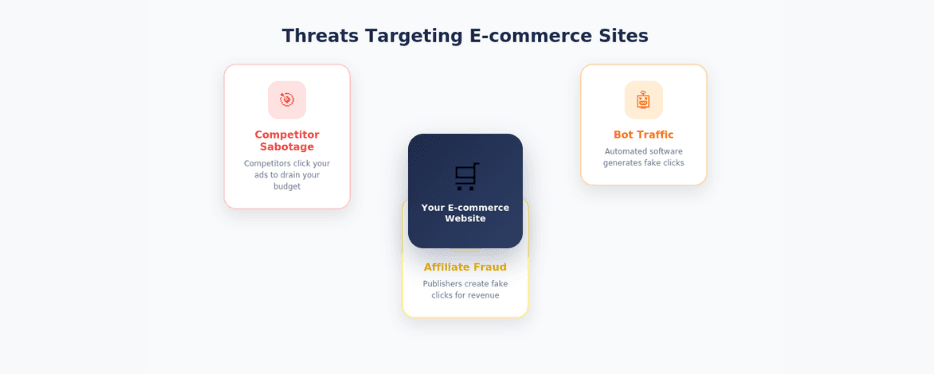
E-commerce sites invest in high-volume, high-cost keywords, making it extremely risky to operate without click fraud prevention.
According to reseach, average click fraud rates range between 15% and 25%. Search campaigns typically see rates of 14-22%, while affiliate and social media channels can exceed these levels during peak seasons.
1. Competitor Sabotage and Price Tracking Bots
Many competitors use automation software to monitor your stock levels and price changes. According to Search Engine Land analysis, invalid click rates have doubled from 2010 to 2024 (5.9% to 12.3%).
Your daily budget depletes within hours, and real customers never see your ads.
2. AI-Powered Bot Attacks
According to the 2025 Imperva Report, AI tools are supercharging bot attacks. ByteSpider Bot alone is responsible for 54% of AI-enabled attacks. Other significant sources include AppleBot (26%), ClaudeBot (13%), and ChatGPT User Bot (6%).
3. API and Business Logic Attacks
44% of advanced bot traffic now targets APIs. These attacks don't just overwhelm API endpoints - they exploit vulnerabilities in API workflows to conduct automated payment fraud, account takeovers, and data exfiltration.
The True Cost of Click Fraud to E-commerce
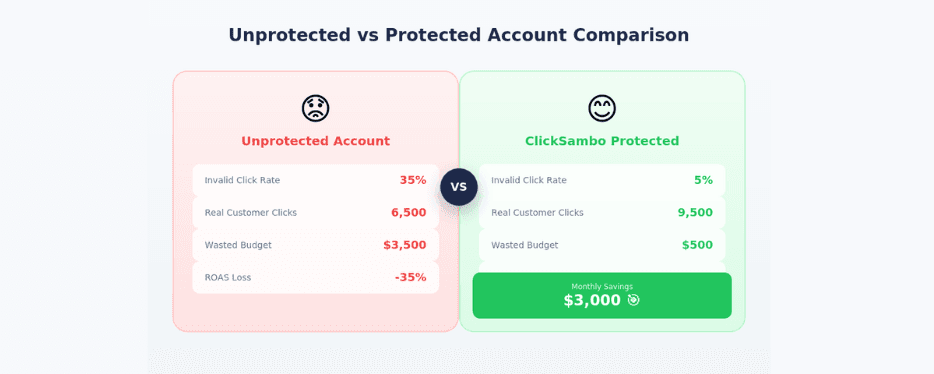
According to the LexisNexis True Cost of Fraud 2025 report, U.S. e-commerce businesses lose an average of $4.61 for every $1 of fraud. Assume you have a monthly Google Ads budget of $10,000 and face an average 12.3% invalid click rate:
| Metric | Unprotected Account | ClickSambo Protected |
| Monthly Clicks | 10.000 | 10.000 |
| Invalid Click Rate | %35 | %5 |
| Real Customer Clicks | 6.500 | 9.500 |
| Wasted Budget | $3,500 | $500 |
| Monthly Savings | 0 | $3,000 |
Note: Invalid click rates in competitive e-commerce sectors can reach up to 35%. According to Juniper Research, e-commerce fraud will rise from $44.3 billion in 2024 to $107 billion by 2029 - a 141% increase.
Click Fraud Rates by Industry
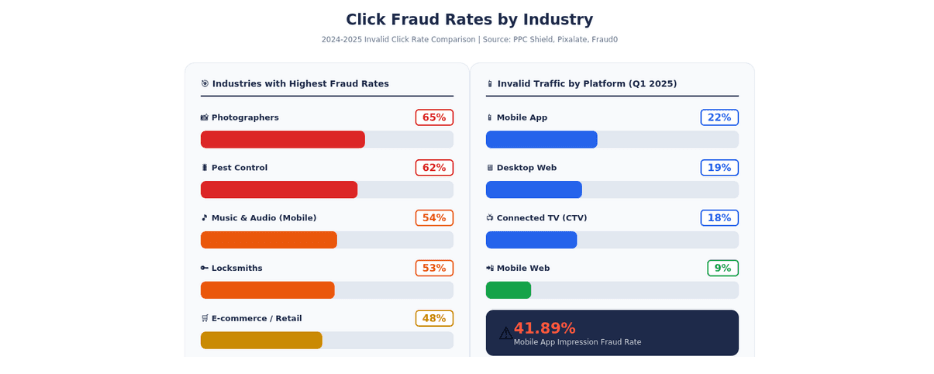
According to data, some industries are hit much harder by click fraud than others:
Industries with Highest Invalid Click Rates (2024):
🔴 65% - Photographers
🔴 62% - Pest Control
🔴 54% - Music & Audio (Mobile App)
🔴 53% - Locksmiths
🟠 48% - Retail/E-commerce (including refund abuse)
Invalid Traffic Rates by Platform (Q1 2025):
📱 Desktop Web: 19%
📱 Mobile Web: 9%
📱 Mobile App: 22%
📺 Connected TV (CTV): 18%
Source: PPC Shield - Pixalate Q1 2025 Benchmark
According to the same report, 21.23% of programmatic ad impressions are invalid, and in mobile apps this rate reaches up to 41.89%.
Proactive Negative Keyword Management
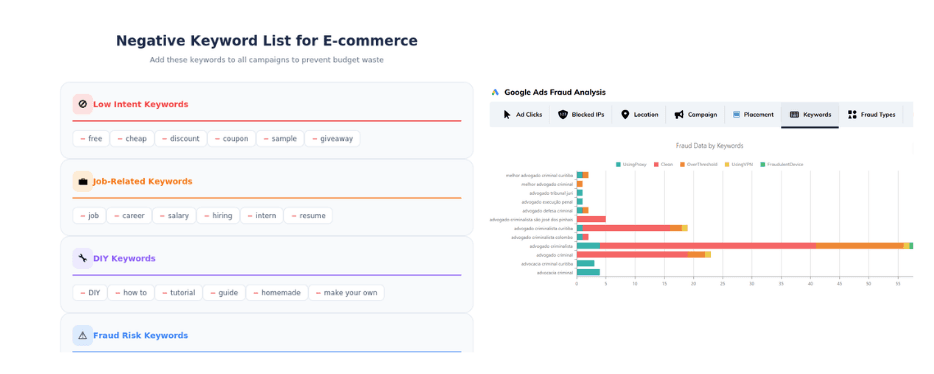
According to analysis, invalid click rates have doubled from 2010 to 2024 (5.9% to 12.3%). This increase is due to AI-powered bots and malware more effectively bypassing basic security filters.
Proactive Approach:
✅ Create a master negative list before launching campaigns
✅ Add industry-specific negative keywords: "free", "used", "fake", "counterfeit", "cheap", "DIY", "how to"
✅ Block job-related keywords: "job listing", "career", "salary", "hiring"
✅ Review Search Terms reports weekly, not monthly
✅ Add made-for-advertising (MFA) sites to your exclusion list
Placement Hygiene
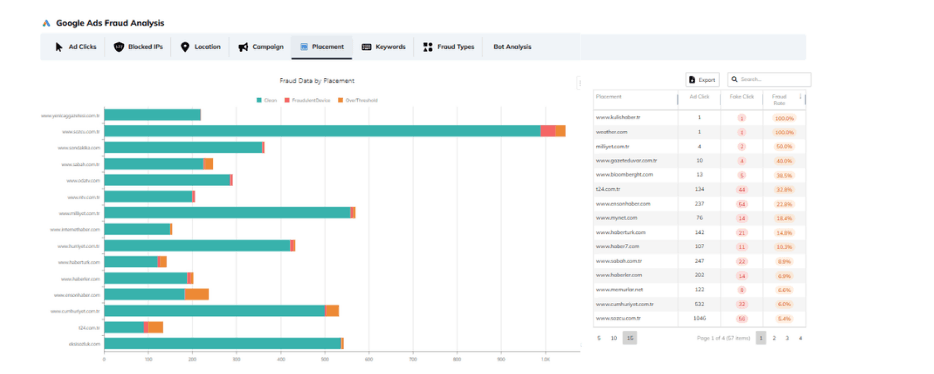
According to the 2025 Imperva Bad Bot Report, 21% of malicious bots use residential proxies - making detection much harder because traffic appears to come from normal home users.
In Performance Max and Display campaigns, your ads can spread uncontrollably. According to data, 21.23% of programmatic ad impressions are invalid.
Low-Quality Placement Indicators:
➔ 0% conversion rate with high clicks
➔ Average session duration under 5 seconds
➔ Bounce rate above 95%
➔ Mobile game apps and children's content
➔ Made-for-advertising (MFA) sites
Warning: According to statistics, MFA sites account for 21% of programmatic web ad impressions.
Geographic Micro-Targeting
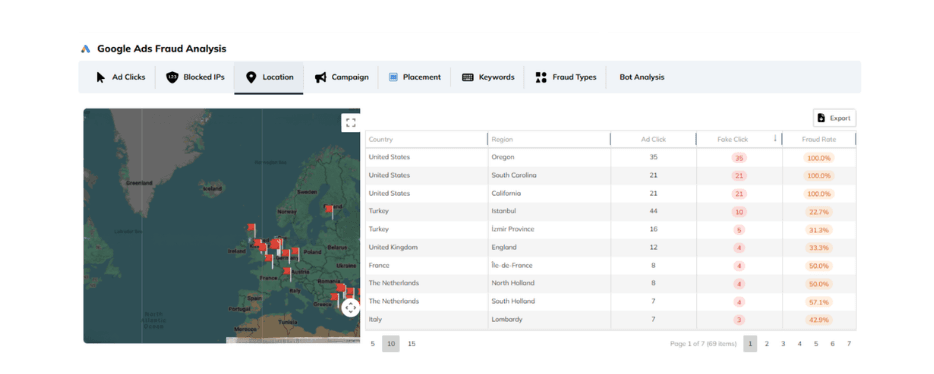
Advertising to an entire country simultaneously unnecessarily spreads your budget thin. Smart location strategy for e-commerce:
✅ Prioritize regions where shipping costs are low
✅ Target high-conversion cities in separate campaigns
✅ Use "People located in" instead of "People interested in" targeting
✅ Analyze regions with high bot traffic and exclude if necessary
✅ Implement time-zone-based ad scheduling
Automated Click Fraud Protection
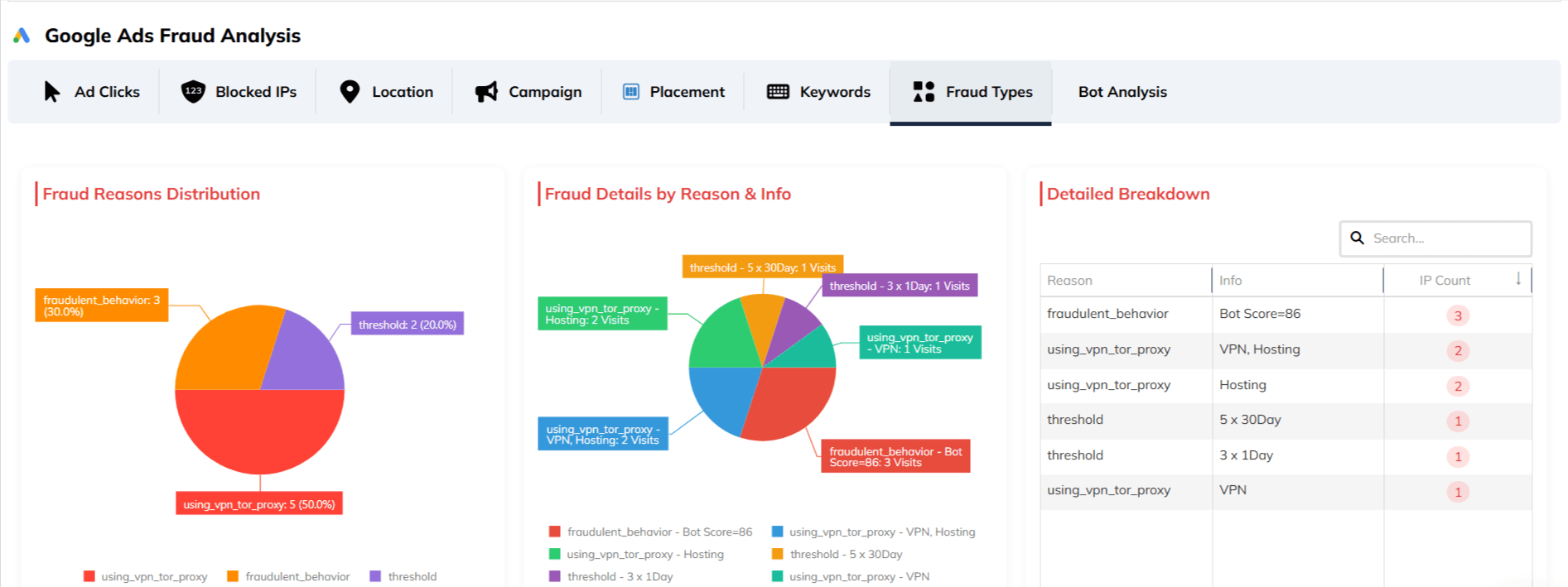
According to statista, global ad fraud losses are expected to reach $172 billion by 2028. Manual protection methods are inadequate against threats at this scale.
ClickSambo provide these advantages:
🔍 IP and Device Fingerprint Analysis
Detects repeated clicks from the same device or behind VPNs. 21% of bot attacks use residential proxies.
🤖 Behavior Analysis
Catches non-human click patterns (instant clicks, zero in-page movement). 9.75% of conversions are invalid, with 7.82% traced to bots.
⚡ Real-Time Blocking
Instantly adds detected fake sources to Google Ads exclusion lists.
📊 Smart Bidding Protection
Clean data ensures Google's Smart Bidding algorithm works correctly.

%51
Bot traffic share
%59
Retail bad bot rate
$107B
2028 e-commerce fraud projection
%12.3
Google Ads invalid clicksPut your e-commerce ads performance under protection
 Get Started Free
Frequently asked questions
According to the 2025 Imperva Bad Bot Report, 59% of traffic on retail websites comes from malicious bots. According to Fraud Blocker data, the average invalid click rate in Google Ads is 12.3%, and this rate can be much higher in competitive sectors.
Google automatically refunds invalid clicks it can detect. However, according to Google's own explanation, it's not possible to detect all invalid clicks. According to Fraud Blocker statistics, invalid click rates have doubled since 2010 (5.9% to 12.3%)
The highest invalid click rates are seen in photographers (65%), pest control (62%), music & audio apps (54%), and locksmiths (53%). In e-commerce, including refund abuse, this rate can reach up to 48%.
No. ClickSambo affect the speed of your site. Protection works entirely through the Google Ads API and doesn't affect your site's performance.
Protection begins the moment integration is complete. Fake traffic sources are detected and blocked within the first 24-48 hours. Measurable improvement in ROAS and conversion rates is typically seen within 2-4 weeks.





 Other
Other