


 Özgül Yavuz Kaddoura
Updated Date:
I Blocked IPs, Tried Click Fraud Software, But My Budget Still Drains in 1 Hour

"I'm blocking suspicious IPs one by one, I even bought click fraud protection software but my ads still burn through the daily budget by mid-morning. The clicks keep coming from new IPs every single day." We've heard this exact sentence from dozens of Google Ads advertisers in the past six months. The same frustration, the same scenario: your campaign is set up correctly, your keywords are dialed in, your targeting is tight but your ad budget evaporates before reaching real customers.
The problem isn't what you're doing. The problem is that the attack method ,rotating residential proxies has outgrown the architectural limits of both manual IP blocking and most click fraud protection tools on the market. In this article, we break down exactly how this attack works, why your current defenses are failing, and how ClickSambo solves it by going beyond IP.
Why Does My Google Ads Budget Drain Every Morning Within 1 Hour?
The messages we receive from advertisers are so consistent they've become a template:
"I launch my campaign at 9 AM, check at 10, and the budget's nearly gone. Plenty of clicks, zero phone calls. I block the IPs but next day, the same attack from completely different addresses."
"We bought a click fraud protection tool. Seemed to work for a few days, then the attackers adapted right back to square one."
"Google support says 'invalid clicks are automatically filtered' but I can see in Analytics that 35 out of 40 clicks bounced in zero seconds. What exactly did Google filter?"
If any of these sound like you, you're not alone. And you're probably not doing anything wrong the attack method you're facing has simply outgrown the capacity your defense tools were designed for.
Why IP Blocking No Longer Works
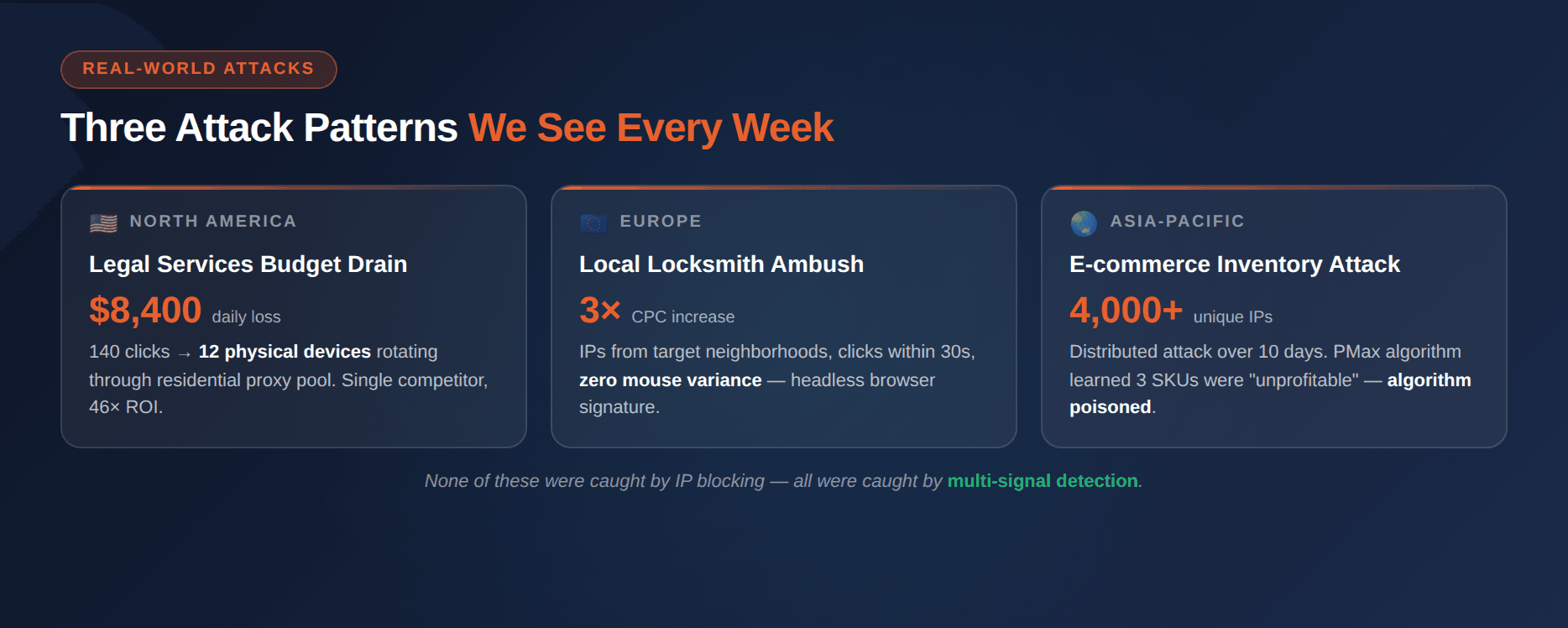
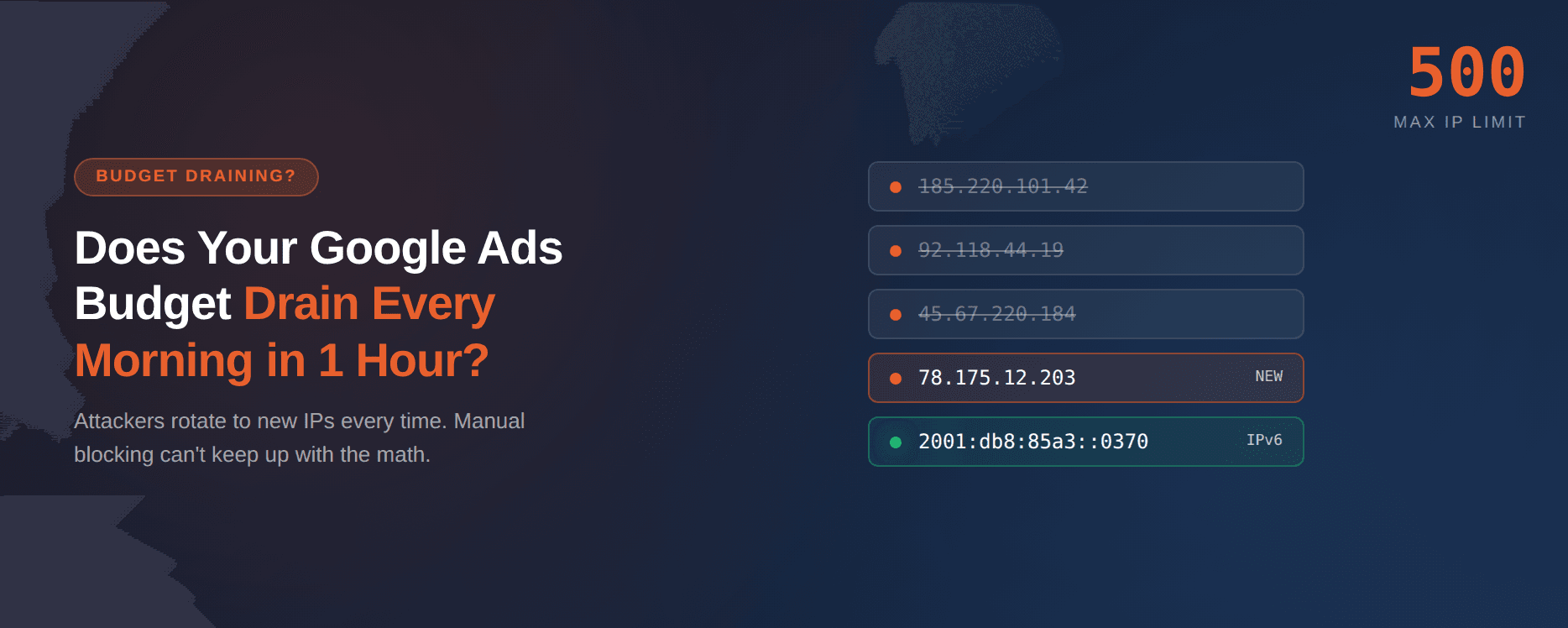
You Can't Fight a Million-IP Army with a 500-IP Limit
A decade ago, click fraud attackers used a handful of data center IPs. Spot them, add them to Google Ads' exclusion list, problem solved. But today's attackers don't use data centers.
In 2026, professional click fraud operations run on residential proxy networks — real IP addresses from real home internet connections. Homeowners sign up for "bandwidth sharing" apps in exchange for small payments, unknowingly renting their connections to attackers.
The scale of these networks is staggering: providers like Bright Data publicly advertise pools of over 400 million residential IPs. With IPv6, that number becomes practically infinite.
Google Ads allows a maximum of 500 IP exclusions per campaign.
Do the math: the attacker rotates through thousands of fresh residential IPs every hour. You can block 500 total. The IPs you blocked yesterday are already abandoned , the attacker moved on hours ago. Manual IP blocking in 2026 is like trying to hold back a river with your bare hands , exhausting effort, zero results.
Why Most Click Fraud Protection Tools Can't Stop This Attack
Many advertisers rightfully take the next step and purchase click fraud protection software. But the results often disappoint. Here's why:
Most tools still rely on IP as the primary identifier
When they detect a fraudulent click, they auto-add that IP to your Google Ads exclusion list but the attacker is already on a different IP by the next click. The process speeds up, but the outcome doesn't change: same cat-and-mouse game, automated.
Residential IPs don't appear in traditional blacklists
Data center IPs are easy to flag known ranges exist. But a residential IP belongs to a real home, a real ISP. That same IP could belong to a genuine customer tomorrow. Blacklist logic breaks down entirely.
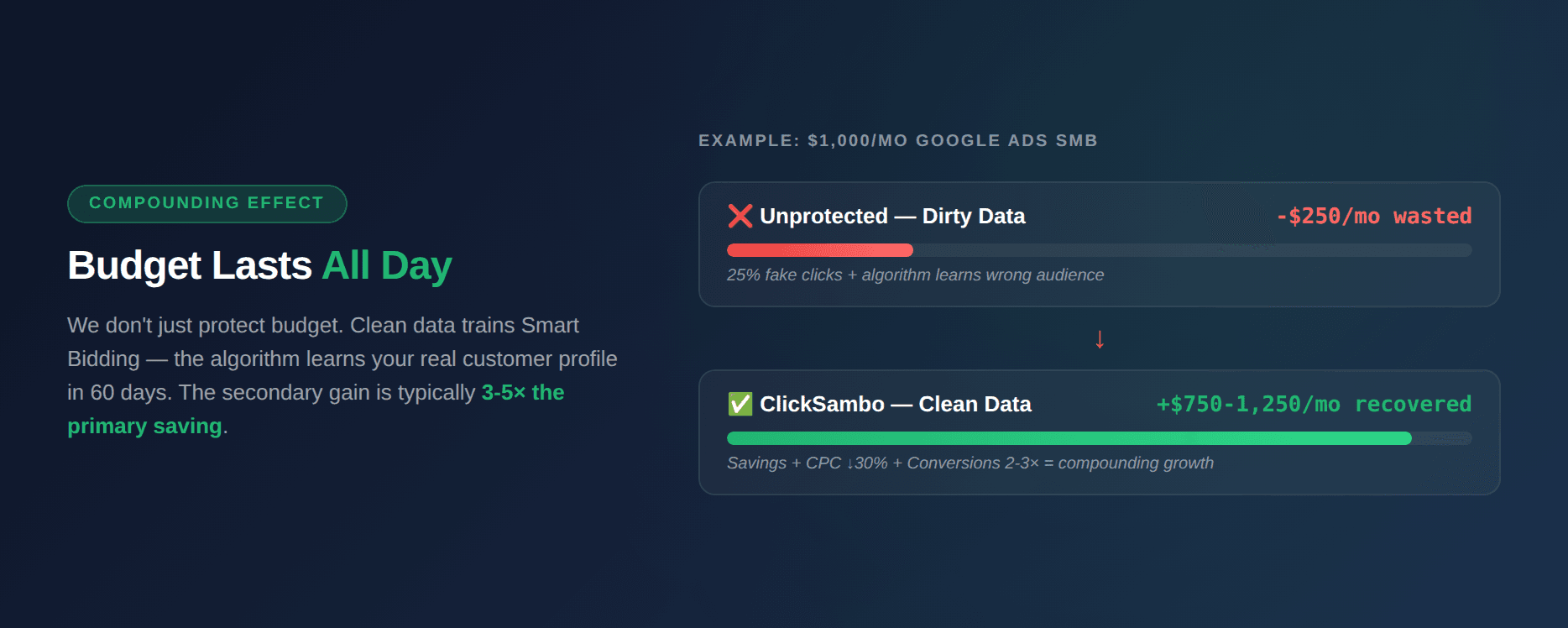
The "block and forget" approach leaves your algorithm polluted
Most tools block bad traffic and move on. But Google's Smart Bidding algorithm has already recorded those fake clicks as "genuine interest." The algorithm continues optimizing toward polluted data your cost per click (CPC) rises, your conversion rate drops, and you conclude "Google Ads doesn't work." The problem isn't your ads , it's your data.
Google's own filters fall short on sophisticated fraud
Google filters general invalid traffic (simple bots, known data center ranges). But residential proxy attacks fall into the "sophisticated invalid traffic" (SIVT) category. Independent audits consistently show Google catches only 40-60% of these fake clicks , the rest silently hits your credit card.
How Your Competitor Is Doing This to You
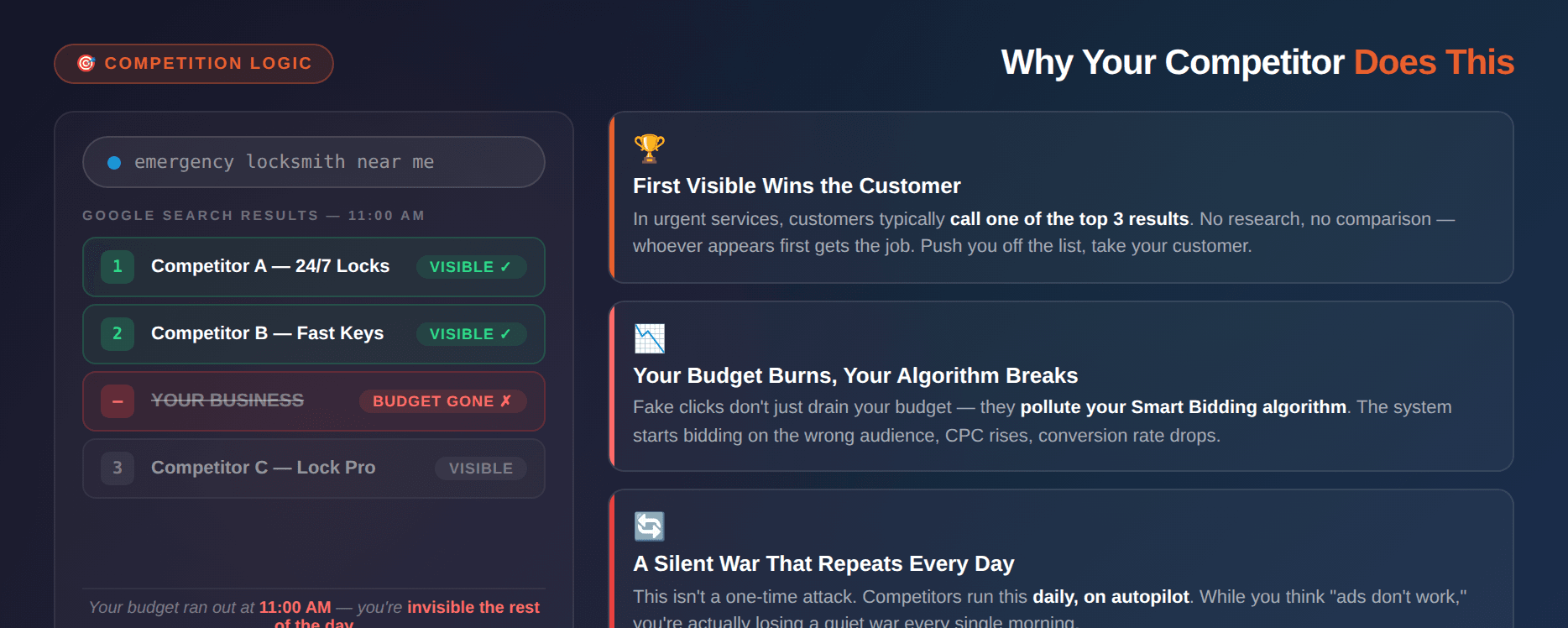
First Visible Wins the Customer — The Logic Is That Simple
When someone Googles "emergency locksmith," "24/7 plumber," or "HVAC repair," they don't research. They look at the top 3 results, call one, and move on. In these industries, whoever appears first gets the customer. No comparison shopping, no quote requests there's an urgent need and the first visible business wins.
Your competitor knows this. Their goal is straightforward: push you off the search results. Once your budget is drained, your ads shut down and you're invisible for the rest of the day. The competitor stays at the top of the list all day — collecting your customers.
This isn't a one-time attack. In competitive industries, this happens every day, on autopilot. While you think "ads aren't working," you're actually losing a quiet ranking war every single morning.
The question isn't "is this happening?" in every competitive industry, it already is. The question is whether you have the right tool to stop it.
How ClickSambo Goes Beyond IP to Solve This
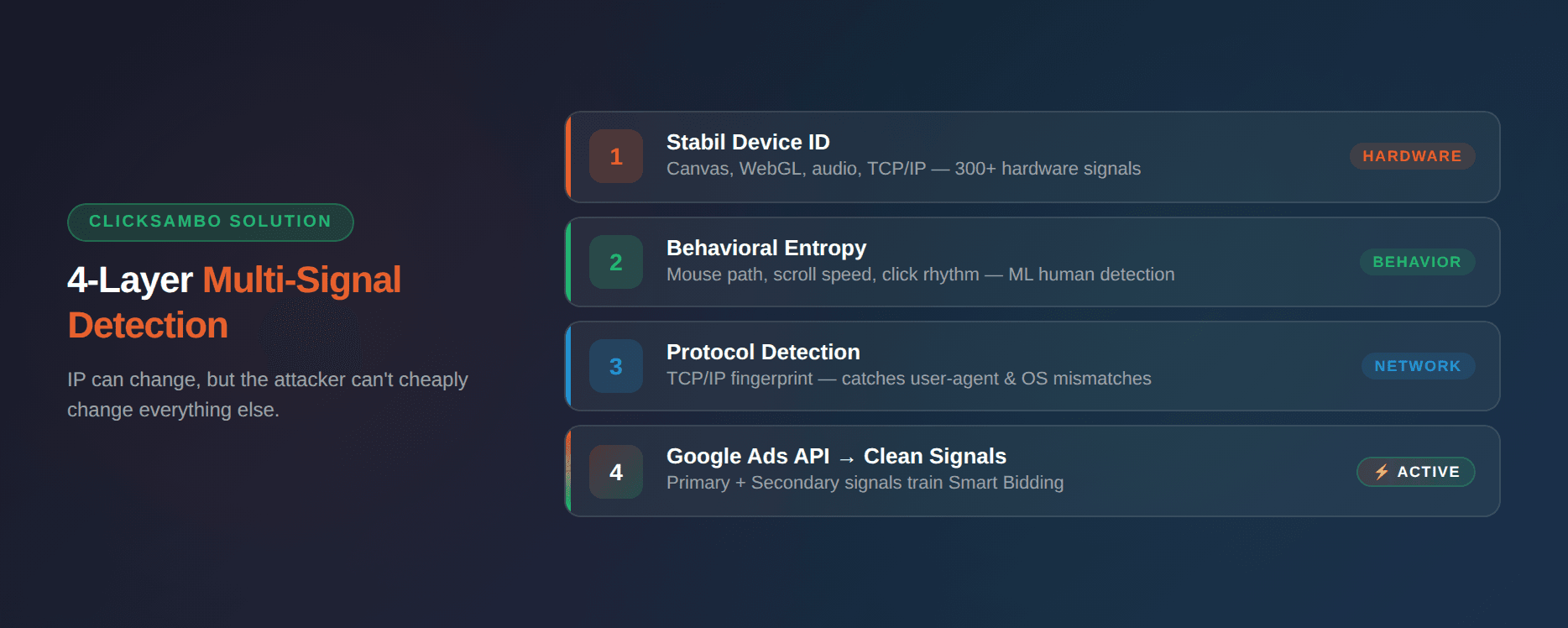
IP Can Change But Devices and Behavior Can't
ClickSambo's approach is fundamentally different: we stopped using IP as the primary identity signal. Because the attacker can change their IP in seconds. But there are things they can't change and that's where we look.
| Layer | Core Technology | Key Functionality | Strategic Impact |
| 1. Stabil Device ID | Device Fingerprinting | Combines 300+ signals (GPU rendering, audio signatures, TCP behavior) into a unique identifier. | (GPU rendering, audio signatures, TCP behavior) into a unique identifier.Anti-Evasion: Recognizes the same physical device in milliseconds, even if it rotates IPs or clears cookies. |
| 2. Behavioral Analysis | Machine Learning (Biometrics) | Distinguishes "messy" human interactions (variable scrolling/pauses) from mechanical bot patterns. | Stealth Detection: Identifies bots even when they use high-quality residential proxies to look "local." |
| 3. Proxy Detection | Protocol Analysis | Cross-references the browser’s claimed OS (e.g., Windows) against the actual TCP/IP stack signature. | Definitive Proof: Flags protocol-level mismatches (e.g., a Linux server posing as a PC) regardless of how "clean" the IP appears. |
| 4. Clean Signal API | Google Ads Feedback Loop | Uses the Offline Conversion API to send "negative signals" for fraud and "positive signals" for humans. | Conversion API to send "negative signals" for fraud and "positive signals" for humans.Algorithm Optimization: Trains Google’s Smart Bidding to avoid fraud in future auctions, lowering CPC and raising conversion rates. |
(Technical deep-dive: ClickSambo Offline Conversion API Setup Guide)
Find out with a free anomaly report
 Get My Free Report
Frequently asked questions
Because attackers now use residential proxy networks that rotate through thousands of home IPs every hour. Google Ads allows 500 IP exclusions per campaign, but the attacker's pool contains millions. The IP you blocked yesterday is already abandoned. IP-based blocking is no longer a viable long-term strategy.
Most click fraud tools still rely on IP as the primary signal, they just automate the blocking process. The attacker uses a new IP for every click, so automated IP blocking hits the same wall as manual blocking. Additionally, most tools only block and move on , they leave Google's Smart Bidding algorithm contaminated with dirty data. ClickSambo goes beyond IP with device fingerprinting, behavioral analysis, and protocol detection, plus actively feeds clean signals back to Google.
Google filters general invalid traffic (simple bots, known data center IPs) effectively. But residential proxy attacks are classified as "sophisticated invalid traffic" (SIVT) and Google's filters are deliberately conservative here because these IPs look identical to real customers. Independent audits show Google catches only 40-60% of this type of fraud.
We look at the device, not the IP. Every device leaves unique hardware traces GPU rendering differences, audio processing patterns, TCP connection behavior, installed fonts, and hundreds more signals. We combine these into a device-specific identity that's nearly impossible to change. Even if the IP, browser, and cookies all change we recognize the same device in milliseconds.
Most protection tools block fraud and stop there. But Google's Smart Bidding algorithm already recorded those fake clicks as "genuine interest." ClickSambo fixes this: we report blocked fraud as "negative signals" via the Google Ads API, teaching the algorithm to avoid similar traffic patterns. Verified real conversions are sent as "positive signals." Result: your algorithm optimizes on clean data, targets the right audience, and CPC drops.
No. Connecting ClickSambo only requires granting MCC access to your Google Ads account — no code changes, no tag installation, no website modifications. Setup takes under 10 minutes with guided onboarding and a dedicated Customer Success Manager. Most SMB clients go from signup to protected traffic the same day.





 Other
Other