


 Özgül Yavuz Kaddoura
Updated Date:
Google Ads 2026 AI Updates: A Practical Guide to Journey Aware Bidding, Smart Bidding Exploration and Demand Led Pacing
Google Marketing Live 2026 in One Read
Google's May 7, 2026 announcement looks like three separate features. In practice the three point in the same direction. Google is moving its bidding system from optimising a single event to optimising the whole customer journey.
In the previous setup, Smart Bidding read a form fill or a purchase as a conversion and learned from that single point. Under the new architecture, the AI also learns what happens after the form fill, whether the deal closed, whether a phone call was a real lead. Three legs support that change, and Google rolled them out across 2025 and 2026.
Leg one reaches a wider query universe (Smart Bidding Exploration). Leg two reads a deeper conversion signal (journey aware bidding). Leg three shifts spend toward days with stronger predicted demand (demand led pacing). Together, Google reports an average 27 percent increase in unique converting users on Search and a 66 percent reduction in manual budget adjustments.
Journey Aware Bidding
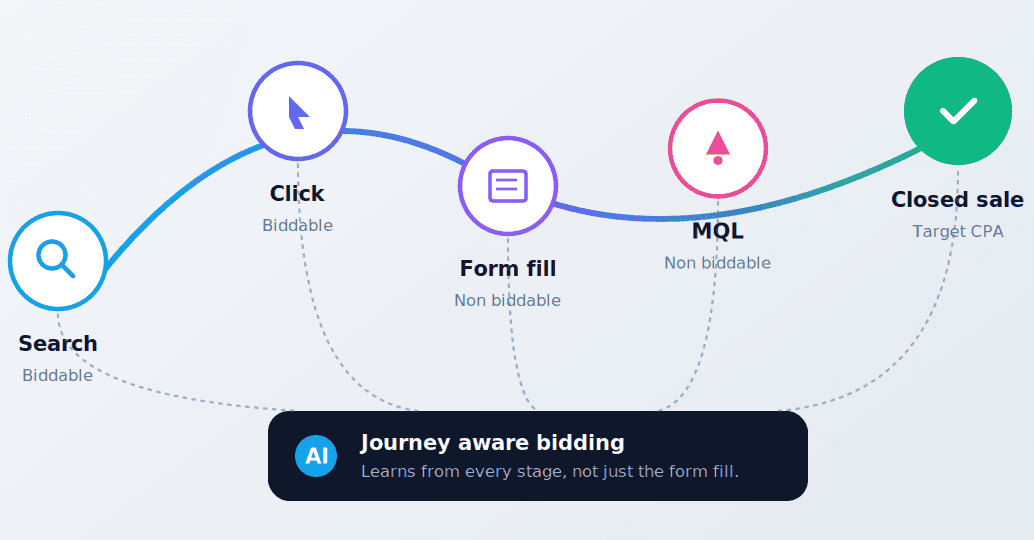
Journey aware bidding is a new Smart Bidding beta for Search campaigns running on Target CPA. In the previous setup the bidding system optimised almost entirely toward front end conversion actions. A form fill counted as a win and the model bid accordingly.
The problem is that a form fill is not a sale. Most lead generation accounts have been forced to choose between two imperfect setups, optimise toward front end conversions and inflate volume with low quality leads, or optimise toward closed deals and starve the model of data.
Journey aware bidding closes that gap. The Search campaign still bids to Target CPA, but the AI also learns from intermediate stages of the journey, phone calls, demo requests, newsletter signups, MQL, SQL, closed sales. Non biddable conversions become learning signals.
The problem is that a form fill is not a sale. Most lead generation accounts have been forced to choose between two imperfect setups, optimise toward front end conversions and inflate volume with low quality leads, or optimise toward closed deals and starve the model of data.
Journey aware bidding closes that gap. The Search campaign still bids to Target CPA, but the AI also learns from intermediate stages of the journey, phone calls, demo requests, newsletter signups, MQL, SQL, closed sales. Non biddable conversions become learning signals.
Best fit accounts
➔ B2B accounts with a lead to sale cycle of weeks or months.
➔ Accounts using Offline Conversion Import or Enhanced Conversions for Leads.
➔ Accounts that have already linked CRM data into Google Ads (Customer Match, conversion goals).
Preparation steps
➔ Review your conversion goals list. Mark which events are biddable and which are non biddable.
➔ If Offline Conversion Import or Enhanced Conversions for Leads is live, verify the data flow.
➔ Audit your front end conversions. Form fills must come from real users. Bots and invalid clicks enter through this door.
Smart Bidding Exploration Expansion
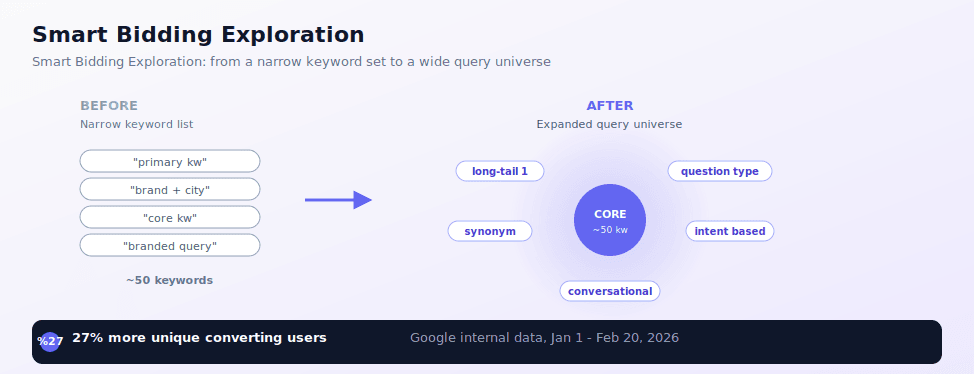
Smart Bidding Exploration first launched in 2025 for Search campaigns. The mechanic is simple, the advertiser gives the bidding system a Target ROAS tolerance, and Google bids on queries that fall slightly outside the tightest ROAS target if they can still convert. Targeting does not loosen, but the query pool widens.
Google reports that Search campaigns using the feature averaged 27 percent more unique converting users.
The May 2026 announcement extends Smart Bidding Exploration to three new campaign types:
➔ Performance Max campaigns, currently in open beta.
➔ Performance Max with product feeds, beta launching in the coming weeks.
➔ Shopping campaigns, beta launching in the coming weeks.
➔ For ecommerce advertisers this is the first time Smart Bidding Exploration applies to Shopping and PMax inventory.
Important caveat
Smart Bidding Exploration widens the query pool, which widens the traffic surface. On a wider surface, invalid traffic (IVT) has more room to slip in. Global IVT report found campaigns with AI Max enabled averaged 5 percent IVT with peaks of 6 percent, while the same accounts with AI Max disabled stayed at 3.7 percent.
Once Smart Bidding Exploration is on, the integrity of your conversion data matters more, not less. With dirty signals Google learns faster, but in the wrong direction.
Demand Led Pacing
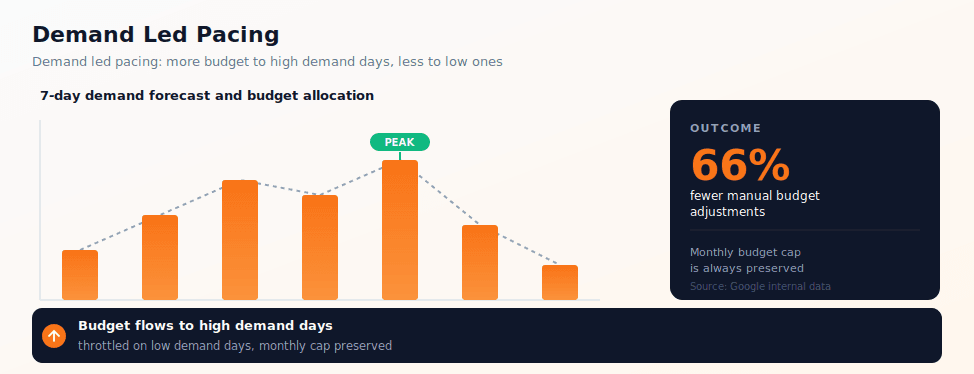
Google had already moved advertisers from daily budgets to campaign total budgets earlier in 2026. Now pacing, the distribution of spend within that budget, is changing too. Demand led pacing uses Google's demand prediction to shift spend toward days with stronger expected demand and pull back on slower days. The monthly cap and daily spending limit are always respected.
Google reports that advertisers using campaign total budgets cut their manual budget adjustments by an average of 66 percent. Demand led pacing builds on that gain.
Verticals where this lands hardest
➔ Seasonal and campaign driven sectors (travel, retail, automotive).
➔ Brands whose demand swings with local events and promotional periods.
➔ Ecommerce accounts during sale events.
Important caveat
Demand led pacing predicts demand from Google's available conversion signal. If the signal is dirty, the model places the demand peak in the wrong window. Before enabling pacing, audit your conversion report for days and hours with anomalous concentration.
AI Max in 2026: Automation Spread Across Search, Shopping and Travel
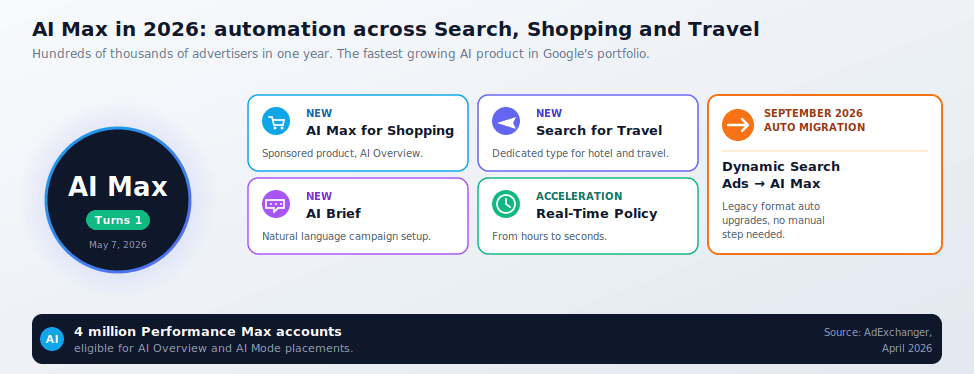
The bidding and pacing announcement is one piece of the larger AI Max story Google has been telling through 2026. Per Google's April 30, 2026 update, AI Max turned one and expanded with several new features:
➔ AI Max for Shopping in closed beta. Ecommerce advertisers can apply AI Max bidding logic to sponsored product and AI Overview placements.
➔ Search Campaigns for Travel launched as a dedicated campaign type for hotel and travel advertisers.
➔ AI Brief, a new conversational setup tool. Advertisers can build a campaign brief in natural language instead of manual toggles and uploads.
➔ Real-Time Policy Reviews moved Responsive Search Ads policy review from hours down to seconds.
➔ Starting September 2026, legacy formats like Dynamic Search Ads will auto-upgrade into AI Max.
Google said AI Max attracted hundreds of thousands of advertisers in its first year and is now the fastest growing AI product in its portfolio. All 4 million Performance Max accounts are eligible to serve in AI Overview and AI Mode placements.
What this means for advertisers
Manual controls are receding. Signal quality is taking their place. Two things become critical, that the campaign correctly defines what a conversion is, and that the clicks reaching that conversion stream come from valid, real users.
The Required Condition for the New Bidding Stack: Signal Hygiene
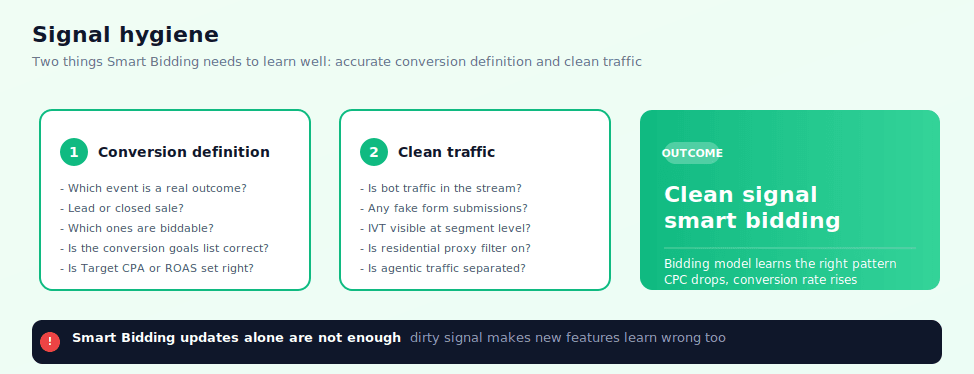
Journey aware bidding, Smart Bidding Exploration and demand led pacing share one assumption, that the conversion signal is reliable. In most accounts this assumption is debatable.
The 2026 global IVT report found an average invalid click rate of 11.5 percent across Google Ads accounts. In AI Max enabled campaigns the rate averages 5 percent and peaks at 6 percent. The same accounts with AI Max disabled stay at 3.7 percent. Enabling AI Max grows the invalid traffic surface by roughly 35 percent.
A new wave: agentic traffic
Perplexity Comet, ChatGPT Atlas and Google Mariner can read a result page, click links, fill forms. Google classifies most of this as general invalid traffic (GIVT) and does not bill for it. But once an agentic click enters the conversion stream, Smart Bidding starts learning from that behaviour.
How dirty signals break the new bidding systems
➔ Bad conversion data teaches the tCPA model the wrong pattern. The model keeps chasing repeats of that pattern.
➔ Smart Bidding Exploration learning from a dirty signal scales the error across a wider query surface.
➔ Demand led pacing predicting from a dirty signal shifts budget to the wrong day.
➔ Journey aware bidding can read the end of the chain, but if the start of the chain is polluted by bot clicks the model keeps misreading.
What advertisers should do
➔ Review Google Ads' IVT credit report weekly. Do not just look at clicks Google filtered, look at the sources still leaking through.
➔ Add ClickSambo as a click fraud protection layer for bots and agentic traffic. Google's retrospective filter runs over hours, and invalid clicks can enter Smart Bidding's learning data within that window.
➔ Audit front end conversion goals (form fills, newsletter signups, contact requests) regularly. Bot fills enter here.
➔ Before enabling Smart Bidding Exploration, segment IVT by geography, device and IP signature. Cleaning before expansion costs less than cleaning after.
How Click Fraud Pollutes Smart Bidding's Learning Data?
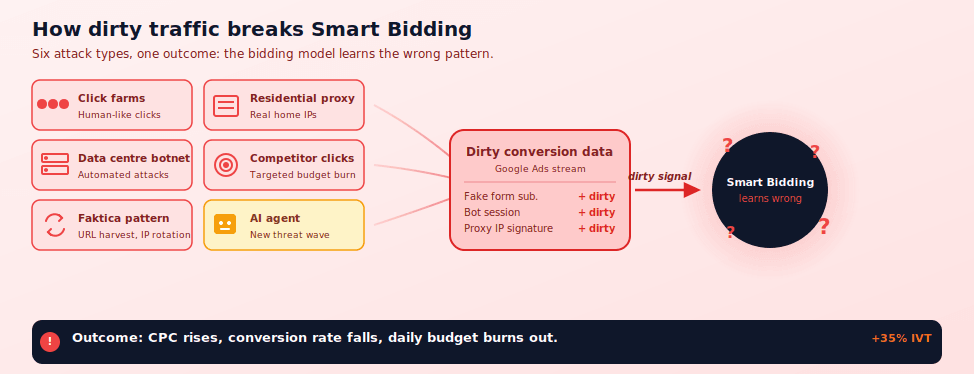
The signal pollution described above is not abstract. Specific fraud types enter the conversion stream from specific places. The six patterns ClickSambo's panel sees most often are below.
Low paid, organised human operators click ads, fill forms, sometimes even add to cart. Behaviour looks human, so Smart Bidding records the traffic as a real lead. As the account optimises, the model learns the click farm behaviour pattern.
Residential proxies
Attackers route traffic through someone else's home internet connection. The IP looks like a real household, slipping past classic IP block lists. Google's IVT filter misses a meaningful share of this traffic.
Data centre botnets
Automated click streams from hundreds of thousands of IPs, often compressed into hours to burn budget fast. The 6 day audit ClickSambo made for a user saw a 35.18 percent invalid rate on May 17 from this attack type.
Manual, targeted, low volume. Each click looks harmless in isolation, but the pattern clusters around specific keywords and time windows. Smart Bidding bids the CPC up in response.
AI agents and agentic traffic
Next generation agentic browsers like Perplexity Comet, ChatGPT Atlas and Google Mariner read result pages, click links and fill forms. Google classifies most of it as GIVT and does not bill, but agentic behaviour that reaches the conversion stream becomes Smart Bidding learning data.
The outcome is always the same: dirty conversion data. With this data, Smart Bidding learns the wrong pattern. CPC climbs, conversion rate falls, daily budget burns out by mid morning. Journey aware bidding, Smart Bidding Exploration and demand led pacing operating on this dirty foundation only spread the error across a wider surface.
ClickSambo: A 4 layer Architecture That Feeds Smart Bidding a Clean Signal
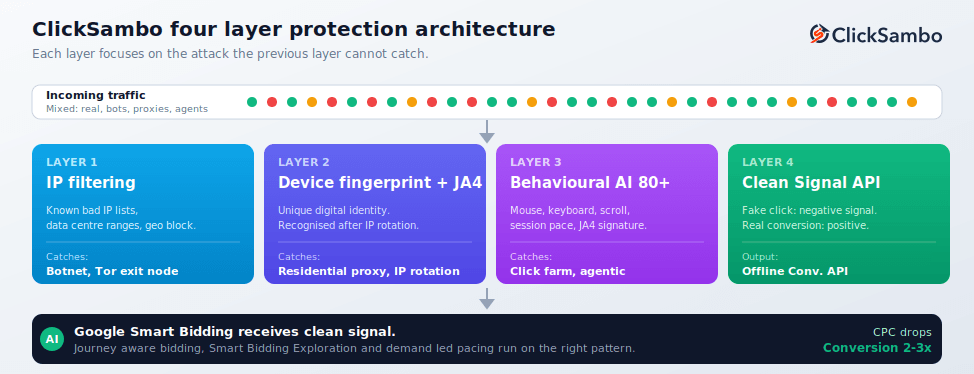
ClickSambo runs every click on a Google Ads campaign through a four layer architecture. Each layer focuses on the attack type the previous one cannot catch. What reaches Smart Bidding at the end is conversion behaviour from real users.
Layer 1: IP filtering
Known bad IP lists, data centre ranges, Tor exit nodes, blacklist signatures. Similar to a classic IVT filter, but runs in real time rather than retrospectively. Most data centre botnets stop here.
Layer 2: Device fingerprinting
Browser, screen, hardware, font, WebGL and network properties combine into a unique digital identity per device.Even when the attacker rotates IP, the same identity follows them and the system recognises them again. Residential proxies and IP rotation attacks get caught here.
Layer 3: Behavioural AI with 80+ algorithms
Mouse movement, keyboard dynamics, scroll pattern, session pace, touch pressure, tab switching and dozens of other behavioural signals are analysed in parallel. Click farms with human operators still behave differently from real customers. Next generation agentic browser clicks also leave a recognisable signature here.
Layer 4: Clean Signal API, the Google Ads feedback loop
This is the layer that separates ClickSambo from other click fraud tools. The system does not just block, it actively trains Smart Bidding. Confirmed fraud is sent back as a negative signal via the Offline Conversion API, real conversions as a positive signal. Signals are marked as zero value secondary conversions, so they do not show up in the Conversions column but do feed the bidding model. The system is compatible with tCPA and tROAS bidding strategies.
Outcomes
➔ The bidding model learns from clean signal.
➔ CPC returns to its natural level, average drops of up to 30 percent.
➔ Conversion rate increases 2 to 3 times.
➔ Daily budget spreads across the day instead of burning out early.
Journey aware bidding, Smart Bidding Exploration and demand led pacing operate on the right pattern.
Setup
ClickSambo is a Google API approved partner. Single OAuth click to connect a Google Ads account under 10 minute setup. 7 day free trial, card collected at signup but no charge during the trial.
Four layer protection blocks click farms, residential proxies, botnets, competitor clicks and agentic traffic in real time
 Start Free Trial
Frequently asked questions
Journey aware bidding was announced on May 7, 2026 at Google Marketing Live 2026. It is currently in beta for Search campaigns on Target CPA. To use it, your account is expected to have Offline Conversion Import or Enhanced Conversions for Leads in place.
In its May 7, 2026 announcement, Google said Smart Bidding Exploration is in open beta for Performance Max campaigns, with the beta for Performance Max with product feeds and Shopping campaigns launching in the coming weeks.
No. Demand led pacing shifts spend up on days with stronger predicted demand and down on slower days. The monthly total budget cap and daily spending limit are always respected.
According to 2026 global IVT report, campaigns with AI Max enabled average 5 percent IVT and peak at 6 percent. The same accounts with AI Max disabled stay at 3.7 percent. That is roughly a 35 percent increase in invalid traffic. This does not mean AI Max should be avoided, but it raises the value of a click fraud protection layer.
Google classifies most agentic clicks as general invalid traffic (GIVT) and does not charge for them. However some agentic clicks do enter the conversion stream, and Smart Bidding can learn from that behaviour, which trains the model in the wrong direction.
Google did not publish a specific minimum threshold. As a rule of thumb, Target CPA based Smart Bidding generally recommends 15 to 30 conversions in the last 30 days. Because journey aware bidding learns from later stages too, including non biddable conversions like MQL and SQL brings the total learning volume to a useful level.
Google did not publish a country level rollout schedule. Historically Smart Bidding updates roll out globally. Smart Bidding Exploration is already available for Search campaigns. Journey aware bidding and demand led pacing roll out gradually at the Google Ads account level.
After confirming fraud through its four layer detection, ClickSambo sends the verified bad clicks back to Google Ads as negative signal via the Offline Conversion API, and real conversions as positive signal. Both are marked as zero value secondary conversions, so they do not appear in the Conversions column but they do feed the bidding model. As a result Smart Bidding learns to avoid the dirty pattern instead of repeating it. The setup is compatible with tCPA and tROAS strategies and works inside AI Max, Performance Max and Shopping campaigns.
Smart Bidding typically needs about 30 days to relearn from clean signal after ClickSambo is enabled. Bot driven fake form fills and invalid clicks drop out of the conversion stream within the first 1 to 2 weeks. By day 30 CPC usually returns to its natural level and conversion rate starts trending up. ClickSambo provides weekly and monthly performance reports so the recalibration progress is observable.





 Other
Other