


 Özgül Yavuz Kaddoura
Updated Date:
Click Fraud Protection for Small Businesses: A Practical Guide
Why Click Fraud Hits Small Businesses Harder
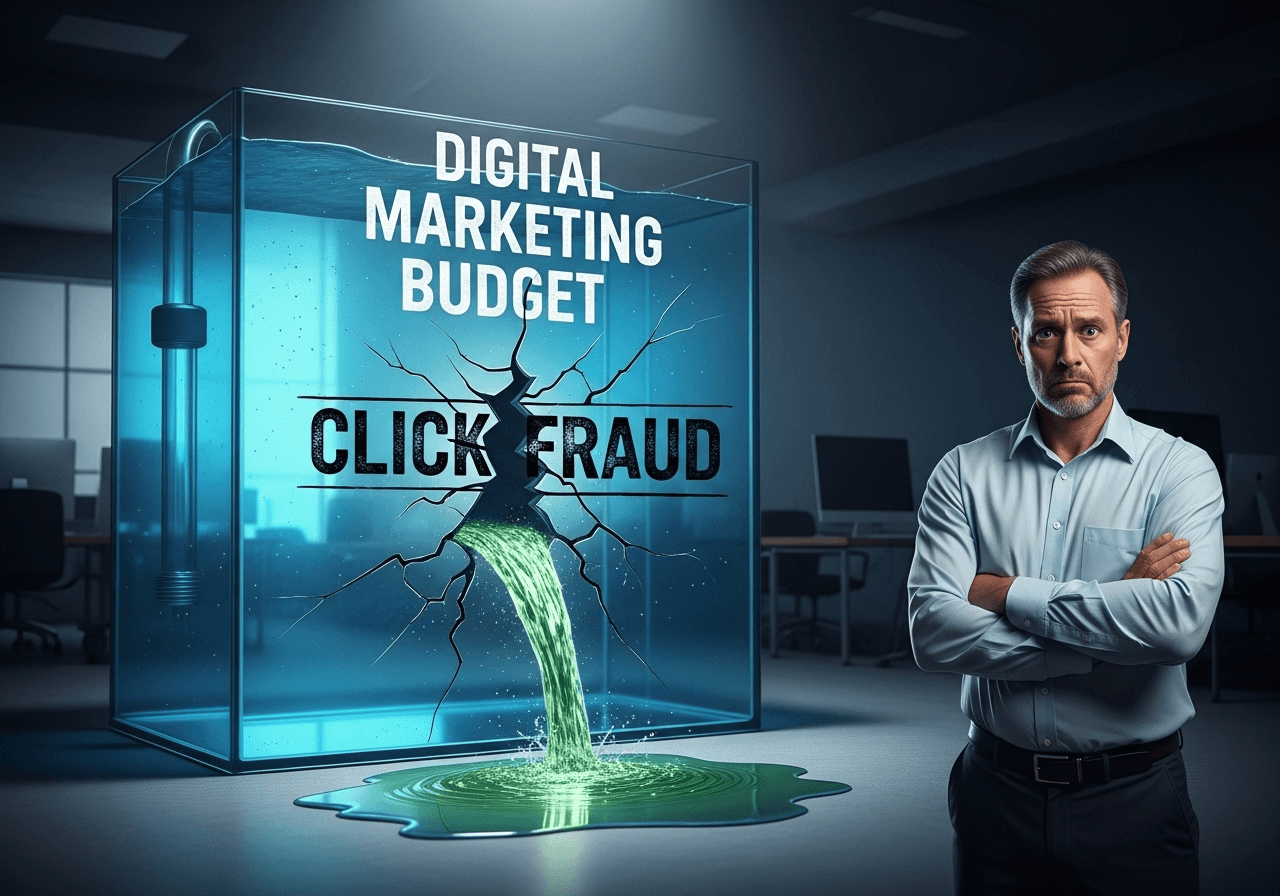
For small and medium-sized businesses, a Google Ads budget is usually limited and every click is expected to pay off. When part of that budget goes to fake clicks from bots, competitors or click farms, the loss is felt right away: fewer real visitors, fewer leads and campaign data that no longer shows what actually works.
What Is Click Fraud?
Click fraud is any click on a pay-per-click (PPC) ad made with no real interest in what you offer, usually to cost you money or earn money for someone else. You pay for the click, but there's no chance of a sale.
It comes from several sources: competitors trying to use up your budget, automated bots, and click farms where low-paid workers click ads by hand.
The problem is large. Juniper Research estimated that 22% of global digital ad spend was lost to ad fraud in 2023, about $84 billion. For a small business, even a smaller share means wasted budget, misleading performance data and fewer chances to reach real customers.
How Click Fraud Hurts Small Business Campaigns
Misleading data: Fake clicks distort your click and conversion metrics, making it hard to judge which campaigns really work. You might pause a campaign that brings customers or put more money into one that mostly attracts fraud.
Smarter bidding, wrong direction: If bots fill out forms, the fake leads are counted as conversions. Smart Bidding then learns from that data and spends more on the sources sending fake traffic, raising your cost per real customer.
Lost reach: Every dollar spent on a fake click is a dollar not spent on reaching a real customer.
A 3-Minute Click Fraud Check
| The 3-Minute SME Audit | Before adding new tools, check your Google Ads and analytics reports for these three warning signs. |
| Night-time spikes | If clicks jump between 1 AM and 5 AM local time with no conversions, automated bots are a more likely cause than late-night customers. |
| Instant exits | If a group of paid visits lasts only a second or two with no interaction, those visitors are very unlikely to be real customers. |
| Clicks from outside your area | If you're a local plumber in London but a noticeable share of clicks comes from other countries, you are likely paying for traffic that can never become a customer. |

Competitor Click Fraud: The Local Business Threat
While global botnets are a threat, many SMEs face a closer enemy: competitor click fraud. In local services such as legal, HVAC or locksmith work, clicks can be expensive. If a click costs $50, a competitor clicking your ad five times in the morning can use up a $250 daily budget before your shop even opens, and your ads stop showing for the rest of the day. Because these clicks often come from ordinary home or mobile connections, they are harder for Google's filters to catch. ClickSambo uses device fingerprinting to recognize the same device even when its IP address changes, and click velocity rules to flag repeated clicks, so competitor attacks are blocked and your budget stays available for real leads.

How ClickSambo Protects Your Campaigns
Protecting a small budget takes an automated, multi-layered approach. Here's how ClickSambo protects your campaigns around the clock.
ClickSambo doesn't wait for weekly reports. Every paid click is checked as it happens against several signals: device fingerprint, visitor behavior, VPN, proxy and Tor use, and how often the same source clicks. Sources identified as fraudulent, such as bots, data centers and repeat clickers, are excluded from your campaigns automatically, so they can't keep draining your budget.

Step 1: See All Your Ad and Lead Data in One Place
You can't fight what you can't see. ClickSambo brings your key data into one dashboard, so unusual patterns are easier to spot. On a single screen, you can see your Google Ads clicks and costs next to the actions visitors actually take, such as calls and WhatsApp messages. When click costs rise but real contacts don't follow, you see it right away, and that gap is often the first sign of fraud.

Step 2: Block Fraudulent Clicks Automatically
Identify and block fraudulent IP addresses at the account level. When attacks come from many neighboring addresses, ClickSambo can also exclude IP ranges, cutting off large parts of bot networks instead of chasing one address at a time.
Automatically block clicks from VPNs, proxies and Tor, which fraudsters often use to hide their real location.
Teach Google what to avoid: ClickSambo sends fraudulent visitors back to Google Ads as negative signals. Over time, this helps Google's algorithm show your ads less often to similar low-quality traffic, so protection keeps improving instead of only reacting to each attack.

Step 3: Review Reports and Adjust
See where fraud comes from: ClickSambo's reports break down fraudulent clicks by location, keyword, placement and fraud type, and show which visitors who clicked your call or WhatsApp buttons were fake. You can quickly see which campaigns, keywords and areas attract the most fake traffic.
Adjust your campaigns: Use these insights to exclude weak placements, rethink keywords that draw mostly fake clicks and tighten location targeting.
Fine-tune your protection: Click thresholds come pre-set for your industry, and you can adjust them, along with other rules, to match your business.


SME Budget Drain
27% of PPC Spend
Non-Human Traffic
42% Bot Presence
Global Financial Risk
$114B Total Loss
The ROI Multiplier
2x Conversion RateYou don't need an enterprise budget to stop fake clicks. ClickSambo blocks fraudulent sources automatically and shows exactly where your money goes.
 Start Free Trial
Frequently asked questions
Yes. In high-CPC industries like legal or locksmith services, a single click can cost $50 or more. At that price, five clicks in a few minutes can use up $250. ClickSambo detects this kind of attack through click velocity and device fingerprinting, and excludes the competitor's IP so repeated clicks stop reaching your budget.
This is a common sign of bots or click farms. Bots can visit your site so the click looks valid to Google, but they rarely go on to call or send a real message. Click farm workers are paid to click, not to contact you. ClickSambo shows clicks and real engagement side by side, so the gap is easy to see.
Rarely, for most small businesses. Local customers usually browse from ordinary home or mobile connections, while fraudsters often use VPNs and proxies to hide their location. If some of your customers use VPNs, for example from work, you can adjust ClickSambo's rules.
When ClickSambo identifies a fraudulent visitor, it sends that visitor to Google Ads as a negative signal. Over time, this helps Google's algorithm learn which traffic has little value and show your ads to it less often, which can lower your cost per acquisition (CPA).



 Other