
 Features
  Industry Verticals
  Customer Segments
  Fraud Types
  Resource
 About
About  Legal
Legal Support
 Özgül Yavuz Kaddoura
Click Fraud: Alarming Statistics for Digital Marketers
The Devastating Impact of Click Fraud: More Than Just Wasted Budget

The repercussions of lacking PPC Fraud Protection and general ad fraud extend far beyond direct financial loss for your business:
Skewed Campaign Metrics: Fake clicks and invalid traffic artificially inflate your Click-Through Rates (CTRs), Impression Counts, and sometimes even generate fake conversions. This makes it impossible to accurately gauge which campaigns, keywords, or targeting strategies are genuinely effective.
Flawed Optimization Decisions: Relying on contaminated data leads to poor optimization choices, such as misallocating budgets to ineffective channels or overlooking potentially profitable ones.
Diminished Return on Investment (ROI): Ultimately, bot traffic and fraudulent interactions never convert into real customers or sales. This directly reduces the true return on your marketing investment and hampers efforts to increase ROI. This is why PPC Fraud Protection is essential for ROI
Brand Reputation & Trust Erosion: Consistent association with low-quality traffic or fraudulent interactions can damage your brand's credibility with potential customers and partners. Brand safety can also be compromised if ads appear alongside inappropriate content due to fraudulent placements.
Wasted Internal Resources: Marketing and analytics teams spend valuable time and resources sifting through fraudulent data, trying to understand discrepancies, and making strategies based on false signals.
Combating Click Fraud: A Shield for E-commerce & Beyond in 2026

In light of these alarming 2025 statistics, effective defense against Digital Advertising Fraud is more critical than ever. How can you safeguard your e-commerce security and other campaigns from fake clicks?
Awareness & Education: Train your team on the types and indicators of click fraud.
Regular Monitoring & Analysis: Continuously analyze your campaign metrics (CTR, conversion rates, bounce rates, session durations), traffic sources, and placements. Look for sudden spikes and inconsistencies.
IP Blocking & Exclusion Lists: Actively block suspicious IP addresses and known sources of fraudulent traffic.
Optimize Geo & Device Targeting: Ensure your ads are only shown in relevant locations and on devices that align with your target audience.
Negative Keywords: Utilize comprehensive negative keyword lists to filter out irrelevant searches that attract invalid traffic.
Ads.txt & App-Ads.txt: Implement these standards to help reduce inventory spoofing. Sites with ads.txt reportedly experience 3.5% less ad fraud.
Advanced Click Fraud Prevention Software: ClickSambo, equipped with advanced analytics and machine learning principles, are the most effective defense. Effective Click Fraud Prevention Software systems:
--> Detect bot traffic and fake clicks in real-time.
--> Evaluate numerous signals including behavioral analysis, device fingerprinting, and IP reputation.
--> Automatically block or flag suspicious activities.
--> Provide clean, reliable data for accurate optimization and decision-making
Ad Fraud's Financial Drain in Numbers
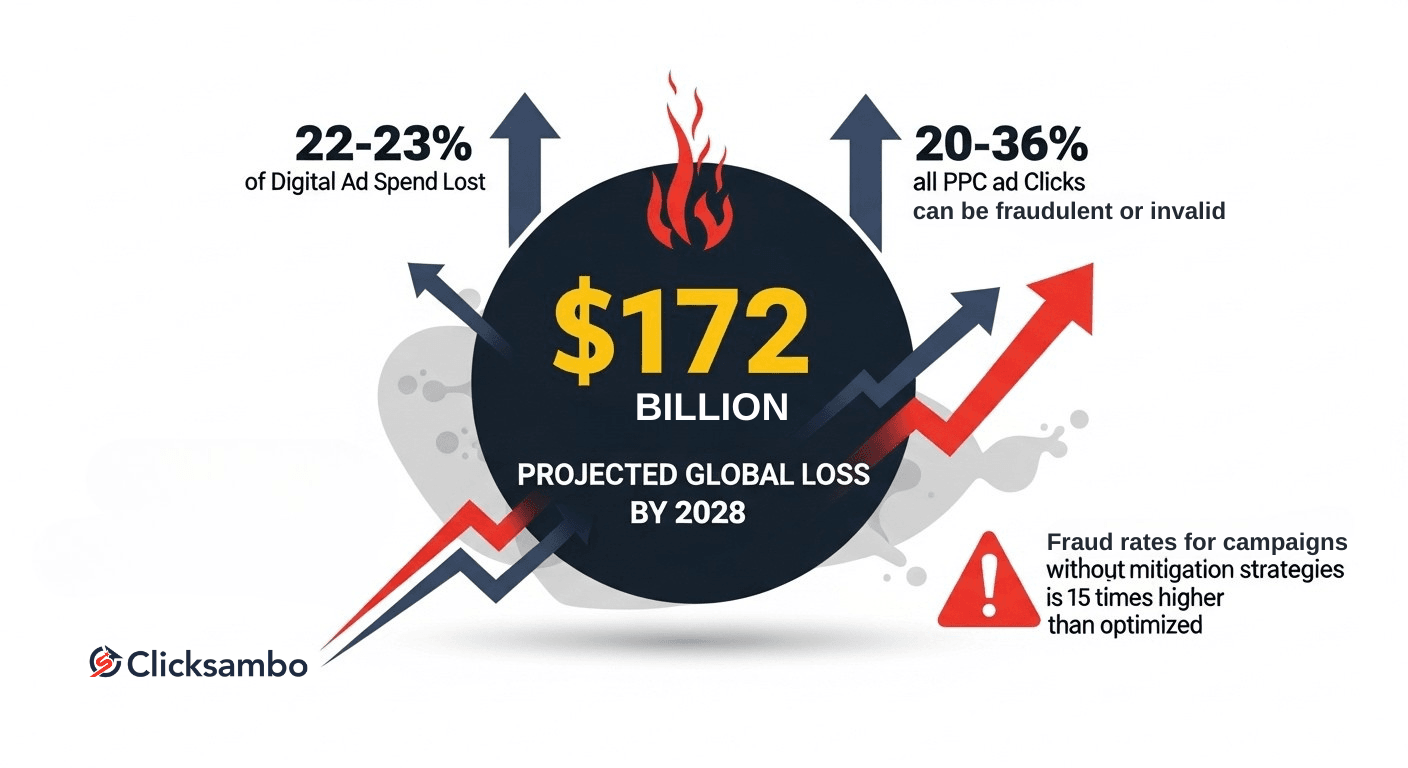
Projected Global Losses:
Global capital lost to Digital Advertising Fraud was estimated at 84 billion in 2023
172 billion by 2028 (Juniper Research; Statista, 2023). Some forecasts suggest click fraud alone could exceed $100 billion by the end of 2025.
Percentage of Spend Wasted: In 2023, approximately 22% of all digital ad spending was attributed to fraudulent activities. This percentage is expected to rise slightly to 23% by 2028, indicating that despite efforts, the sheer volume of ad spend means larger absolute losses (Juniper Research; Statista, 2023).
Daily Impact: Some reports have estimated that ad fraud costs the marketing industry an average of $51 million dollars per day (Juniper Research, 2019 analysis). While this is an older figure, the trend suggests the daily drain remains significant.
Invalid Traffic Across Channels
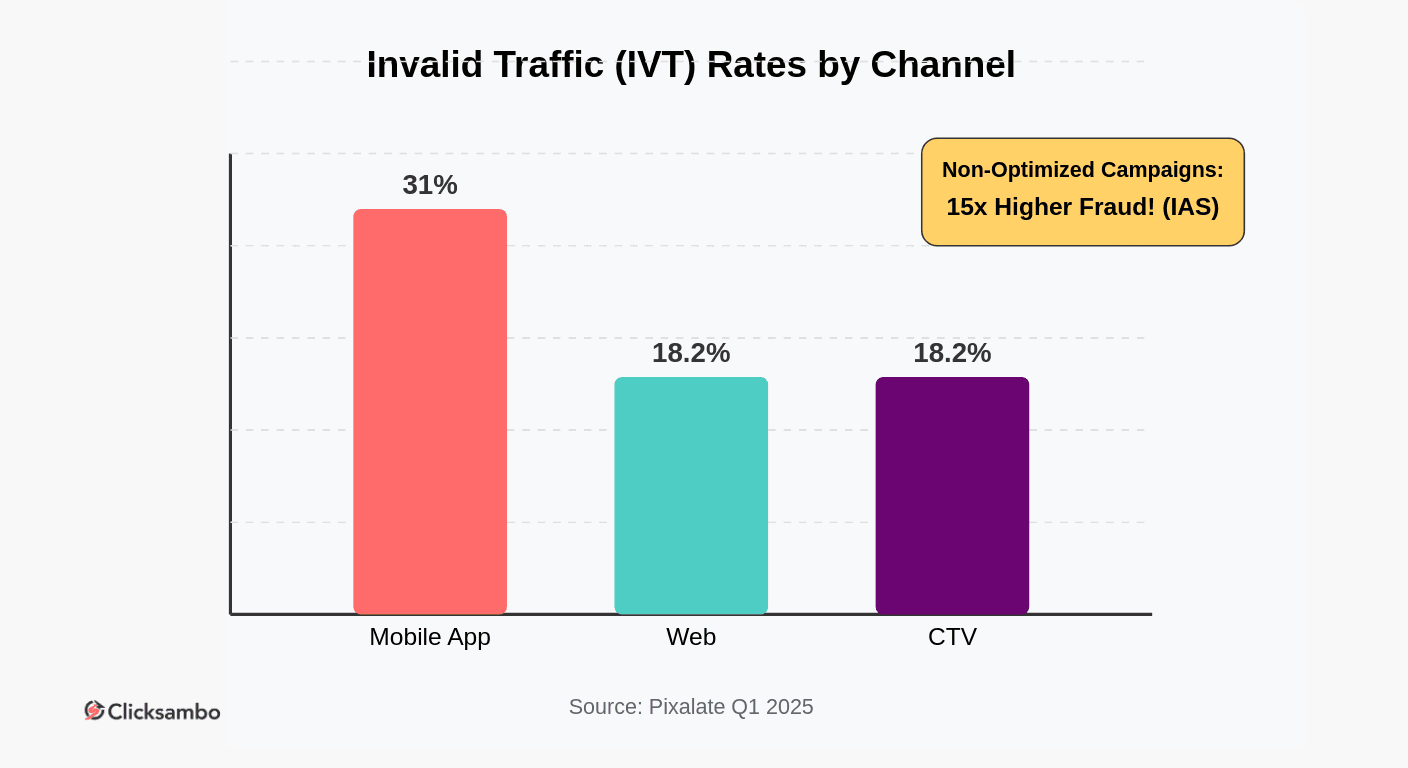
Mobile App Mayhem: Mobile app traffic consistently shows high IVT rates. Pixalate’s Q1 2025 "Invalid Traffic (IVT) & Ad Fraud Benchmarks" report indicated that 31% of global mobile app traffic was invalid. This makes Mobile Ad Fraud a top concern for app marketers.
Web and CTV Vulnerabilities: The same Pixalate report found that 18.2% of global desktop and mobile web traffic and 18.2% of global Connected TV (CTV) traffic was invalid in Q1 2025. While lower than the rates seen in Mobile Ad Fraud, these are still substantial figures, especially considering the growing investment in CTV.
The Unoptimized Campaign Penalty: Campaigns lacking proactive fraud mitigation strategies experience significantly higher fraud. IAS’s Media Quality Report (end of 2024 data) found that non-optimized campaigns saw fraud rates of 10.9%, which was 15 times higher than optimized campaigns (0.7% fraud rate).
Search Ad Clicks: While search ads generally have lower fraud rates (around 11% reported by some studies), their volume is immense. Google Shopping ads, for instance, drive 76% of retail search ad spend (Wordstream). Even a smaller percentage of fraud here translates to significant wasted budget, underlining the need for PPC Fraud Protection
Stay Secure with ClickSambo
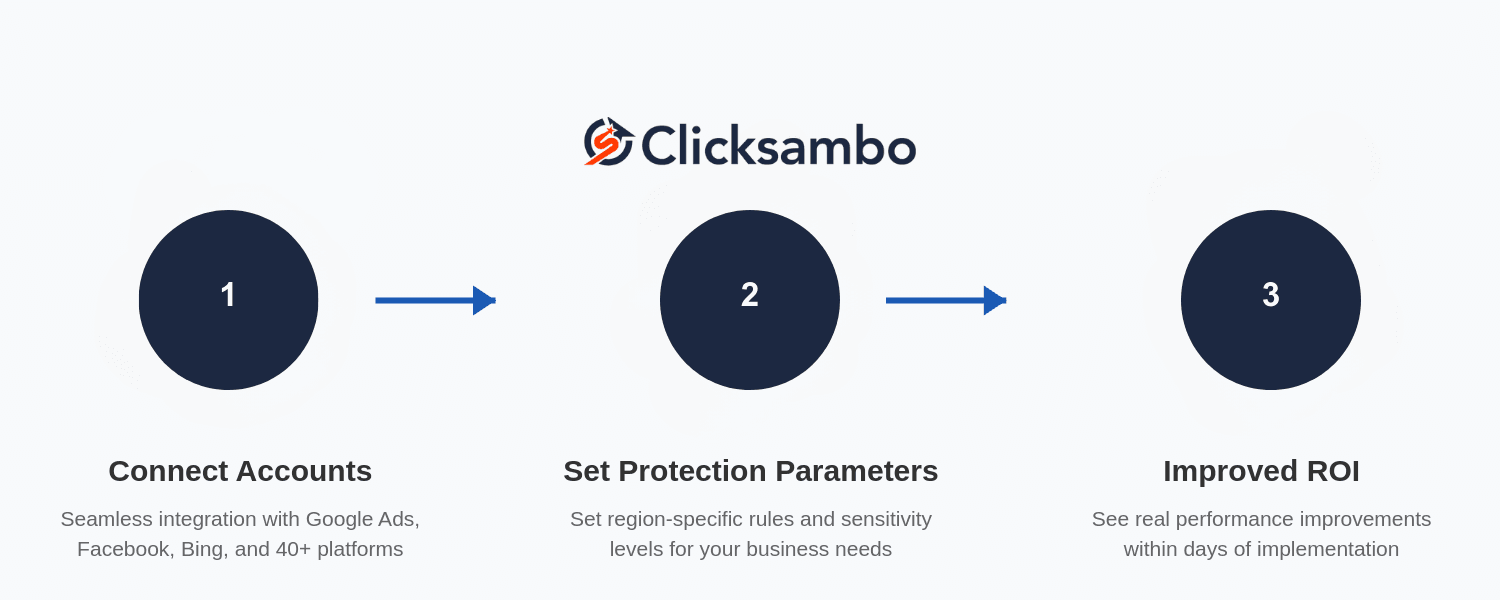
At ClickSambo, we are dedicated to helping advertisers navigate this landscape with robust PPC Fraud Protection. Our advanced analytics capabilities, customizable rules, and (future-integrated) AI-powered detection infrastructure are designed to shield your campaigns from invalid traffic and bots, ensuring:
--> Your ad budget reaches genuine potential customers.
--> Your campaign data is accurate and reliable.
--> You can confidently increase ROI.
--> Your e-commerce security and overall digital marketing success are enhanced.
We understand that every click and every penny of your ad spend matters. Protect your budget, trust your data, and accelerate your growth with ClickSambo.

Billions in Losses
$172 billion by 2028
High Bot Traffic
22-23% of all digital ad spending
Channel Vulnerabilities
Mobile App 31% IVT, web and CTV 18.2% IVT
Mobile Ad Fraud Lead
$35 billion lost to fraud in 2023Ad fraud is a multi-billion dollar industry in 2026. Proactive defense is the only way to keep your ROI above water.
 Start Shield
Frequently asked questions
Mobile devices are prime targets for Mobile Ad Fraud because they offer unique vulnerabilities like "SDK Spoofing" and "Background Clicking." Unlike desktop environments, mobile apps often run processes in the background that users cannot see. Fraudsters exploit this to generate thousands of "invisible" clicks and impressions. Without dedicated PPC Fraud Protection tailored for mobile environments, these high-velocity attacks can go undetected for months.
In 2026, most ad platforms use machine learning to optimize bids. When your data is contaminated by bot traffic, the platform's AI "learns" from those fake interactions. It begins to bid more aggressively on keywords and audiences that attract bots, thinking they are high-intent users. This "signal contamination" is why Click Fraud Prevention Software is essential; it cleans your data so your AI bidding models focus exclusively on humans who actually convert.
While the global figure is staggering, individual businesses can drastically reduce their exposure. Statistics show that "non-optimized" campaigns suffer fraud rates 15 times higher than those with active mitigation. By implementing Digital Advertising Fraud safeguards—such as automated IP blocking, behavioral biometrics, and real-time PPC Fraud Protection—small businesses can reclaim up to 20% of their wasted budget and reinvest it into legitimate growth.
Inventory spoofing occurs when a malicious site pretends to be a premium publisher (like the New York Times) to attract high-value ads. Implementing Ads.txt and App-Ads.txt creates a public record of authorized digital sellers for your domain. Research indicates that sites using these protocols experience significantly less Digital Advertising Fraud, as it makes it much harder for fraudsters to "spoof" your inventory and steal your ad revenue.




 Other
Other